
If you’re applying for Canadian permanent residency through Express Entry, a Provincial Nominee Program, or Francophone Mobility, proving your French proficiency isn’t optional—and choosing the wrong exam can cost you CRS points, weeks of prep time, and money you didn’t need to spend.
Both TEF Canada and TCF Canada are accepted by Immigration, Refugees and Citizenship Canada (IRCC). But they’re built differently, scored differently, and — depending on your natural strengths as a non-native speaker — one will genuinely feel easier than the other.
French isn’t a side quest in your Express Entry profile either. It can add up to 50 additional CRS points on its own, and in recent 2026 draw cycles, French-category rounds have opened with noticeably lower cut-offs than the general pool — which is exactly why so many candidates are weighing TEF against TCF right now, often picking up French as a second language for the first time in their lives.
This guide breaks down the real differences — format, scoring, cost, and task types — so you can pick the right exam before you start preparing, not after.
What TEF Canada and TCF Canada Actually Are
TEF Canada (Test d’Évaluation de Français) was created in 1998 by the CCI Paris Île-de-France and has been recognised by IRCC for economic immigration purposes since 2002. It’s administered by CCI France Canada and delivered through authorised centres, including Alliance Française locations across India, Canada, and internationally.
TCF Canada (Test de Connaissance du Français) is developed and administered by France Éducation International, an operator under the French Ministry of Education that also produces the DELF and DALF diplomas. It’s delivered through approved centres including Alliance Française and Campus France.
Both tests:
- Are accepted for Express Entry (CRS points), Provincial Nominee Programs, and Canadian citizenship applications
- Are valid for 2 years from the results date
- Are aligned to the CEFR (Common European Framework of Reference for Languages)
- Require all four sections to be completed on the same day
- Carry no negative marking
- Convert your raw score into NCLC levels (Niveaux de Compétence Linguistique Canadiens) — the French-language equivalent of the CLB scale used for English
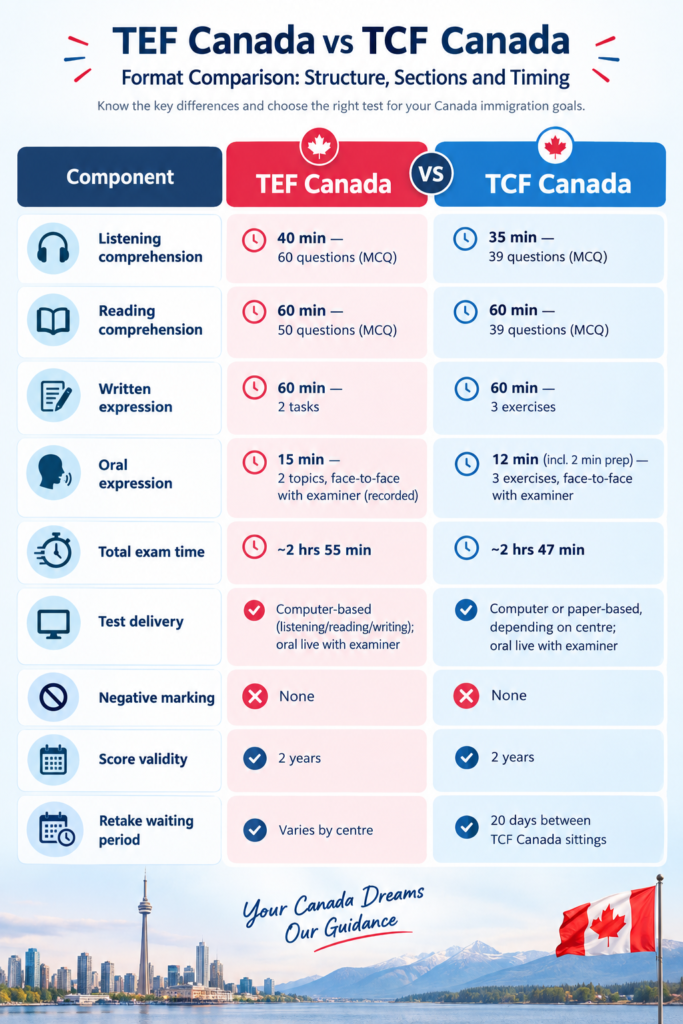
Format Comparison: Structure, Sections, and Timing
| Component | TEF Canada | TCF Canada |
|---|---|---|
| Listening comprehension | 40 min — 60 questions (MCQ) | 35 min — 39 questions (MCQ) |
| Reading comprehension | 60 min — 50 questions (MCQ) | 60 min — 39 questions (MCQ) |
| Written expression | 60 min — 2 tasks | 60 min — 3 exercises |
| Oral expression | 15 min — 2 topics, face-to-face with examiner (recorded) | 12 min (incl. 2 min prep) — 3 exercises, face-to-face with examiner |
| Total exam time | ~2 hrs 55 min | ~2 hrs 47 min |
| Test delivery | Computer-based (listening/reading/writing); oral live with examiner | Computer or paper-based, depending on centre; oral live with examiner |
| Negative marking | None | None |
| Score validity | 2 years | 2 years |
| Retake waiting period | Varies by centre | 20 days between TCF Canada sittings |
Section-by-Section: Where “Easier” Actually Comes Down To
The two tests are close in total length, but the internal pacing — and the actual task types — are genuinely different. That’s what determines which one will feel easier to you specifically.
Listening Comprehension
TEF packs more questions into less time — 60 questions in 40 minutes, roughly 40 seconds per question, built from everyday and professional audio clips (announcements, dialogues, interviews). TCF gives you 39 questions in 35 minutes, closer to 54 seconds per question. Candidates who understand spoken French quickly but need a beat to lock in an answer often find TCF’s pacing less stressful. Candidates with fast, confident listening comprehension may actually prefer TEF, since there’s less idle time between questions to lose focus.
Reading Comprehension
Both sections run 60 minutes, but TEF has considerably more questions to get through — 50 versus TCF’s 39, roughly 1.2 minutes per question on TEF versus 1.5 minutes on TCF. TEF’s reading section is also structured in four distinct parts: identifying a simple document’s purpose, understanding a document in detail, following a text’s logic and organisation, and grasping the general meaning of a sentence. If reading speed in French is your weaker skill, TCF’s slightly more generous pacing is the more forgiving of the two.
Written Expression
TEF gives you 2 tasks across 60 minutes (30 minutes each): one asks you to continue an article in a coherent way, the other asks you to express and justify a personal point of view in at least 200 words. TCF gives you 3 exercises in the same 60 minutes (roughly 20 minutes each) — typically something like recounting a personal experience informally, writing a clear blog-style account of an event for readers, and presenting two opposing viewpoints on an issue before taking your own position. TEF suits candidates who write more slowly but want to develop one or two ideas in real depth; TCF suits candidates comfortable managing several shorter, differently-styled tasks against the clock.
Oral Expression
This is where the two tests diverge most. TEF’s oral section runs 15 minutes across two parts, both live with an examiner: first, a short exchange where you gather information about a document (5 minutes), then a section where you present a document and argue your position persuasively (10 minutes). TCF’s oral section is shorter overall (12 minutes) but spreads across 3 shorter exercises and includes 2 minutes of built-in preparation time before you have to speak. For candidates who freeze up when asked to respond instantly, that prep buffer on TCF can be the difference between a strong and a weak score. For candidates who perform better in a natural, flowing conversation than in a structured, timed exercise, TEF’s format may feel more comfortable.
Bottom line: there’s no universally “easier” test — only a better fit for your specific strengths. TCF tends to suit candidates who want more processing time on listening and reading, more varied shorter writing tasks, and built-in prep time before speaking. TEF tends to suit candidates who write in more depth per task and are comfortable with a faster overall pace and fewer, longer oral exchanges.
Computer-Based vs Paper-Based, and Accommodations
TEF Canada’s listening, reading, and writing sections are delivered on computer, with the oral section conducted live with a certified examiner and recorded. TCF Canada offers both computer-based and paper-based sittings depending on the centre — worth confirming directly when you register, since your comfort typing versus handwriting in French can genuinely affect your writing-section pace.
If you need specific accommodations for a disability, France Éducation International maintains a dedicated accommodations process for TCF candidates; TEF centres typically handle accommodation requests directly through the local Alliance Française or CCI-affiliated centre. Raise this early in your registration, well before your exam date.
Understanding How Your Score Becomes CRS Points
Both exams don’t hand you a percentage — they hand you a raw score per skill, which IRCC then converts into an NCLC level (1 to 12) using an official conversion table. That NCLC level is what actually determines your Express Entry points.
A few benchmarks worth knowing as you plan your prep:
- NCLC 7 is generally the minimum level needed across all four skills to become eligible for CRS points under the French-language category, and is also the commonly cited target for Canadian Experience Class eligibility
- NCLC 9 typically represents the level where you start earning maximum CRS points for a first official language
- NCLC 10 is the threshold most commonly associated with the bilingual bonus (French + English)
Requirements can also differ by immigration stream — for instance, some programs like the Federal Skilled Trades stream have historically asked for a lower listening/speaking benchmark than reading/writing, while citizenship applications have their own minimum. Because these program-specific thresholds are periodically reviewed by IRCC, confirm the exact current requirement for your specific pathway before finalising your study target.
The exact raw-score cutoffs for each NCLC level differ between TEF Canada and TCF Canada, and IRCC updates these conversion tables periodically — third-party numbers circulating online are often outdated or inconsistent with each other. Before you commit to a target score, pull the current official conversion chart from the IRCC website or your test centre rather than relying on a blog table, since an outdated cutoff can lead to under-preparing for the level you actually need.
Cost Comparison (India)
Pricing varies by city and centre, but as a general reference point from Alliance Française centres in India:
- TEF Canada (all 4 modules): approximately ₹26,000 (GST included)
- TCF Canada (all 4 modules): approximately ₹18,000–25,000, depending on the centre
Since both are flat-rate exams for the immigration version—you can’t opt out of individual sections—factor the full fee into your prep budget from the start, along with any coaching or mock-test costs. Confirm current pricing directly with your nearest Alliance Française or approved test center, as fees are revised periodically and can vary meaningfully between cities.
Preparation Resources: An Underrated Factor
This doesn’t get talked about enough, but it genuinely affects how “easy” a test feels in practice. TEF Canada has been the more commonly chosen test for longer, which means a deeper ecosystem of official guides, past-paper-style practice sets, and coaching specifically built around its format. TCF Canada’s resource base has been growing but is still comparatively thinner in most markets, including India.
If you’re the kind of learner who relies heavily on timed practice tests to build exam-day confidence, that resource gap is worth weighing alongside the format differences above—you may need to lean more on structured coaching for TCF simply because fewer self-study materials exist.
How to Prepare, Whichever Test You Choose
- Start with a diagnostic mock in both formats before committing—this tells you more about which test suits you than any comparison article can
- Build all four skills in parallel, not sequentially—your weakest skill sets your NCLC ceiling, since IRCC scores each skill independently
- Practice full-length, timed mocks, not just isolated sections—fatigue in the final section of a nearly 3-hour exam is real, and only shows up under full-length conditions
- Record yourself for the oral section and review it critically, or better, get feedback from a trained evaluator—self-assessment on speaking is notoriously unreliable
- Time-box your writing practice to match the real exam (30 min/task for TEF, ~20 min/exercise for TCF) so exam-day pacing isn’t a surprise
Which Exam Should You Choose?
- Strong at listening but need more time to think while speaking → TCF Canada
- Confident writer who prefers fewer, deeper tasks → TEF Canada
- Aiming for a specific CRS point target → check the current CLB/NCLC conversion chart for both tests before deciding, since point equivalencies aren’t identical question-for-question
- Applying for a federal bilingual public-service role → TEF Canada has wider recognition for this specific purpose
- Want more available prep material and coaching options → TEF Canada currently has the deeper resource ecosystem
- Unsure of your current level → take a diagnostic mock in both formats before committing—this is the only reliable way to know which format actually suits you
Common Mistakes Candidates Make
- Choosing based on which test a friend took, without checking whether their strengths (fast listener, slow writer, confident speaker) match your own.
- Not checking the retake waiting period before booking a second attempt under time pressure
- Relying on an outdated NCLC conversion table found on a random blog instead of the current official chart
- Registering for the wrong version—TEF/TCF Canada is not the same as TEF/TCF Québec (TEFAQ) or TCF Tout Public, and each has a different structure and purpose
- Skipping a full-length timed mock and only practicing sections in isolation, which hides how fatigue affects performance in the final section
- Assuming self-employment or informal French practice “counts” as prep without structured, exam-format practice under timed conditions
A 2026 Update Worth Knowing
In June 2026, IRCC tightened verification procedures across all approved language tests, including TEF Canada and TCF Canada—officers now cross-reference applicant photos against test results, check testing-provider fraud alerts, and refer irregularities to IRCC’s Tips and Reports Management Unit. IRCC has also said it’s reviewing irregularities tied to a French-category Express Entry round.
The takeaway for genuine applicants: sit the test yourself at an approved center, keep your registration and result records, and be wary of anyone promising a “guaranteed” score. A misrepresentation finding doesn’t just lead to refusal—it can result in a 5-year ban from Canada.
FAQs:
Q1. Can I switch from TEF to TCF later, or vice versa?
Ans.Yes—there’s no restriction preventing you from taking the other test if your first result doesn’t hit your target. Just factor in the mandatory waiting period between attempts of the same test (TCF Canada requires 20 days between sittings).
Q2. Which test has faster results?
Ans. TCF Canada results are typically issued within 2–4 weeks. TEF Canada timelines are similar; check current processing times with your test center, as these can shift.
Q3. Does one test convert to higher CRS points than the other?
Ans. Neither test inherently caps you lower—both convert to CLB/NCLC levels, which then map to CRS points. Your actual score in each skill area determines your points, not which test you chose.
Q4. Is the exam computer-based or paper-based?
Ans. TEF Canada’s listening, reading, and writing sections are computer-based, with the oral section conducted live with an examiner. TCF Canada offers both computer-based and paper-based options depending on the centre—confirm which format your local centre offers when you register.
Q5. Can I take only some sections instead of all four?
Ans. Not for the immigration version. Both TEF Canada and TCF Canada require all four skills for Express Entry and citizenship purposes—you can’t opt out of a section the way you sometimes can with other test versions like TCF Tout Public.
Q6. How many times can I retake the test?
Ans. There’s no cap on total attempts, but each test has its own required waiting period between sittings — plan your timeline accordingly if you’re working toward an Express Entry deadline.
Q7. Do I need a passport-size photo or ID for registration?
Ans. Yes, both tests require identity verification and typically a passport-style photo as part of registration—confirm the exact documentation list with your chosen center, since requirements can vary slightly by location.
Ready to Find Out Which Format Suits You?
Book a free TEF–TCF diagnostic session with our team—we’ll assess your current French level across all four skills and tell you which exam gives you the fastest, most realistic path to your target CRS score.
