
Canada continues to provide immigration opportunities for skilled workers who speak French, particularly those interested in settling outside Quebec. Understanding the Provincial Nominee Program French Requirements in 2026 can help prospective immigrants identify suitable provincial pathways, prepare for approved French-language examinations, and strengthen their permanent residence profiles.
French proficiency can be valuable for applicants considering provincial nomination, especially in provinces that actively recruit bilingual and Francophone workers. However, French-language requirements vary depending on the province, immigration stream, and applicant’s professional background.
This guide explains how French language skills can support provincial immigration, the language scores applicants may need, and the main differences between Provincial Nominee Programs and French-language Express Entry selection.
What Is the Provincial Nominee Program (PNP) in Canada?
The Provincial Nominee Program (PNP) allows participating Canadian provinces and territories to nominate individuals who meet their immigration and economic requirements.
Each province establishes its own eligibility criteria based on factors such as education, work experience, occupation, language proficiency, and connections to the province.
Applicants may be eligible through:
- Express Entry-aligned PNP streams: For eligible candidates who meet both provincial and federal Express Entry requirements.
- Non-Express Entry PNP streams: For applicants qualifying under participating provincial immigration pathways outside Express Entry.
A nomination through an Express Entry-aligned PNP can provide 600 additional Comprehensive Ranking System (CRS) points, significantly strengthening a candidate’s chances of receiving an invitation to apply for permanent residence.
However, a provincial nomination does not automatically guarantee permanent residence. Applicants must also satisfy applicable federal immigration requirements.
Provincial Nominee Program French Requirements in 2026
The Provincial Nominee Program French requirements are not identical across Canada. Some immigration streams are specifically designed for French-speaking workers, while others accept French as one of Canada’s two official languages.
A candidate’s required proficiency may depend on:
- The province or territory selecting applicants.
- The specific PNP stream.
- The applicant’s occupation and work experience.
- Whether English proficiency is also required.
- The program’s eligibility and selection criteria.
For French-language category selection under federal Express Entry, candidates need at least NCLC 7 in all four French-language abilities. This federal requirement should not be confused with the requirements of every provincial immigration stream.
1. Ontario PNP French Language Requirements
Ontario offers an immigration pathway known as the Ontario Express Entry French-Speaking Skilled Worker Stream.
This pathway is designed for eligible French-speaking skilled workers who also possess English-language proficiency and meet the relevant work experience, education, and other immigration requirements.
French and English Language Requirements
Applicants must demonstrate:
- French language proficiency of at least NCLC 7 in listening, speaking, reading, and writing.
- English language proficiency of at least CLB 6 in all four language abilities.
- Valid results from approved language examinations.
Candidates must also qualify under the applicable federal Express Entry program and receive a Notification of Interest from Ontario before submitting a provincial application.
Meeting the language thresholds alone does not guarantee eligibility or a nomination.
2. New Brunswick French Immigration Pathways
New Brunswick actively supports Francophone immigration and offers pathways that may be relevant to French-speaking candidates.
Its immigration selection system includes the New Brunswick Strategic Initiative Stream, with pathways for Francophone workers in New Brunswick and eligible candidates meeting provincial Francophone priorities.
New Brunswick has continued conducting targeted selection rounds for Francophone candidates during 2026.
Applicants must examine the specific pathway requirements, including language proficiency, employment circumstances, provincial connections, and other applicable conditions.
French-language ability can therefore form an important part of a candidate’s immigration strategy, but eligibility depends on more than language scores.
3. Manitoba PNP and French-Speaking Candidates
Manitoba also provides immigration opportunities for skilled workers who demonstrate English or French language proficiency and meet provincial eligibility criteria.
Under the Manitoba Provincial Nominee Program, language proficiency may contribute to an applicant’s selection points.
For example, the Skilled Worker Overseas pathway awards language assessment points based on demonstrated proficiency. Eligible applicants may receive points for a second official language when they meet the relevant benchmark.
However, candidates must also satisfy stream-specific conditions, such as qualifying connections to Manitoba, professional qualifications, and other selection requirements.
French proficiency alone does not establish eligibility for the Manitoba PNP.
French Language Tests Accepted for Canada PR
Candidates applying through French-language immigration pathways generally need results from an approved language examination.
For federal Express Entry, Immigration, Refugees and Citizenship Canada (IRCC) recognizes two French-language examinations:
1. TEF Canada
The Test d’évaluation de français is used to assess French proficiency for Canadian immigration purposes.
2. TCF Canada
The Test de connaissance du français is another approved examination used to demonstrate French-language skills.
Both examinations assess four language abilities:
- Listening
- Speaking
- Reading
- Writing
Applicants should confirm the accepted test types and minimum language scores for their specific provincial immigration pathway.
What Is NCLC 7 for French Immigration?
NCLC stands for Niveaux de compétence linguistique canadiens, the Canadian language benchmark system used to assess French-language proficiency.
NCLC 7 represents a particular level of French-language ability across listening, speaking, reading, and writing.
For the federal Express Entry French-language proficiency category, applicants must achieve a minimum of NCLC 7 in all four abilities.
An overall average is not enough if an individual skill falls below the required level.
The benchmark is particularly relevant to candidates preparing for Canada PR through French-language category-based selection or Ontario’s French-Speaking Skilled Worker Stream.
How French Language Skills Can Improve CRS Points
French proficiency can strengthen a candidate’s Express Entry profile through additional Comprehensive Ranking System points.
Under the applicable CRS rules, eligible candidates may receive:
- 25 additional CRS points: For NCLC 7 or higher in all four French abilities, with CLB 4 or lower in English or no English test.
- 50 additional CRS points: For NCLC 7 or higher in all four French abilities and CLB 5 or higher in all four English abilities.
- 600 additional CRS points: For a qualifying provincial nomination through Express Entry.
These are separate CRS provisions. The provincial nomination points are not a French-language bonus, and applicable limits on additional CRS points must be considered.
French-speaking candidates may also qualify for category-based Express Entry draws without receiving a provincial nomination.
French Express Entry Draws in 2026
French-language proficiency has remained an important category under Canada’s Express Entry selection system.
According to CIC News, IRCC conducted a French-language proficiency draw on July 9, 2026, issuing 5,000 invitations to apply with a CRS cut-off score of 420.
Further French-language category draws took place during July and August 2026, demonstrating continued selection activity for eligible Francophone candidates.
These federal draws are different from Provincial Nominee Program selections. A candidate invited through the French-language category does not necessarily need a provincial nomination.
Past invitation scores also do not guarantee the CRS threshold for future draws.
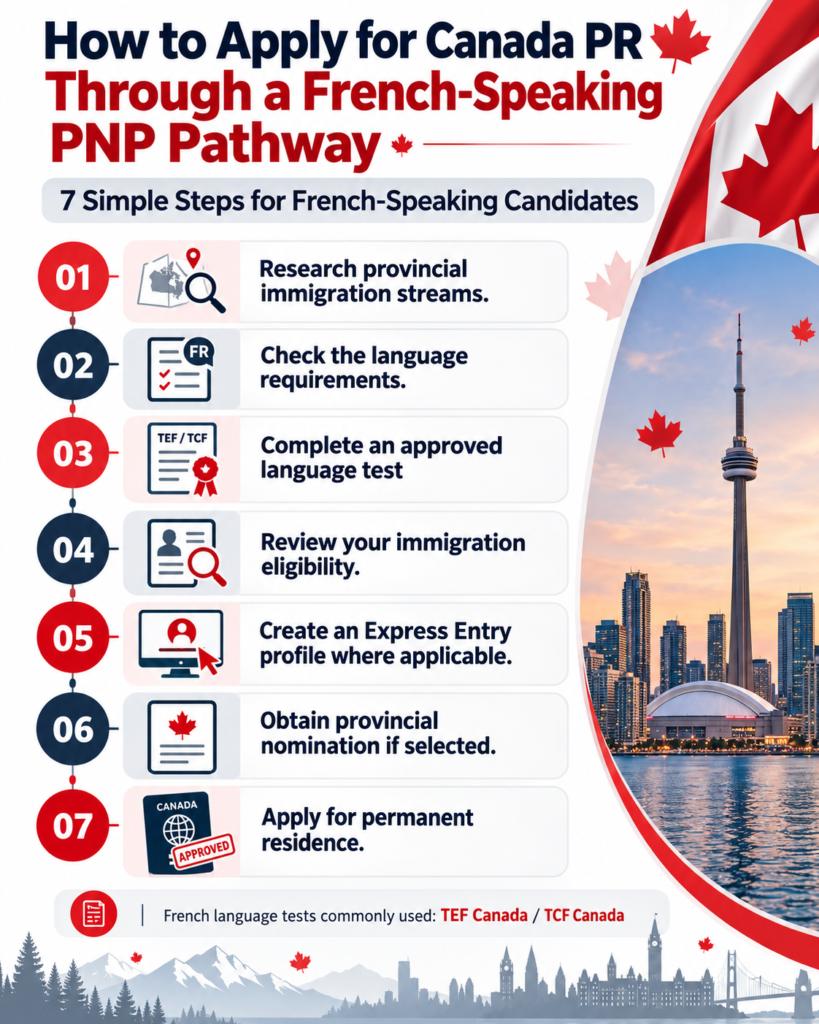
How to Apply for Canada PR Through a French-Speaking PNP Pathway
Applicants considering a French-speaking provincial immigration pathway can follow these general steps.
Step 1: Research provincial immigration streams.
Identify the province and immigration stream that match your occupation, education, language abilities, and settlement plans.
Step 2: Check the language requirements.
Determine the minimum NCLC or CLB levels required for your selected pathway.
Step 3: Complete an approved language test
Prepare for TEF Canada or TCF Canada and obtain valid results demonstrating your French-language proficiency.
Step 4: Review your immigration eligibility.
Assess your professional experience, educational credentials, employment situation, and provincial connections against the program requirements.
Step 5: Create an Express Entry profile where applicable.
Applicants pursuing Express Entry-aligned provincial streams must satisfy the requirements of an eligible federal immigration program.
Step 6: Obtain provincial nomination if selected.
Follow the relevant provincial application or invitation process. Candidates receiving and accepting a qualifying Express Entry nomination may obtain 600 additional CRS points.
Step 7: Apply for permanent residence.
Once invited through the applicable immigration process, submit a complete permanent residence application with the required supporting documents.
Is Learning French Worth It for Canada PR in 2026?
Learning French may provide meaningful immigration advantages for candidates who already possess suitable education, work experience, and other qualifications.
French proficiency can help applicants:
- Qualify for federal French-language category-based Express Entry selection.
- Meet language requirements for eligible Francophone-focused PNP streams.
- Earn additional CRS points when applicable.
- Demonstrate bilingual proficiency for employment and settlement.
- Explore immigration opportunities in French-speaking communities outside Quebec.
However, achieving NCLC 7 does not automatically guarantee an invitation, provincial nomination, or permanent residence.
Applicants should evaluate their complete immigration profile before choosing a pathway.
Prepare for TEF Canada or TCF Canada with LinguoPrep
Developing strong French-language skills requires consistent preparation across listening, speaking, reading, and writing.
At LinguoPrep, learners can explore structured French-language training designed to strengthen practical communication skills and support their preparation for Canadian immigration language requirements.
Whether you are starting with basic French or working toward the NCLC level needed for your intended immigration pathway, selecting an appropriate study plan is an important first step.
Contact LinguoPrep to learn more about French classes, language preparation, and study options for your learning goals.
Frequently Asked Questions
Q1. What are the Provincial Nominee Program French Requirements in 2026?
Ans. The requirements vary by province and immigration stream. Some pathways require specific French and English benchmark levels, while others award selection points for language proficiency. Applicants must check the requirements of their chosen program.
Q2. Is NCLC 7 compulsory for every French PNP application?
Ans. No. NCLC 7 is required for the federal Express Entry French-language proficiency category and Ontario’s French-Speaking Skilled Worker Stream, but other provincial programs may apply different requirements.
Q3. Can I get 600 CRS points through a provincial nomination?
Ans. Yes. Candidates who receive and accept a qualifying Express Entry-aligned provincial nomination are awarded 600 additional CRS points under the applicable rules.
Q4. Which French tests are accepted for Canada Express Entry?
Ans. IRCC accepts TEF Canada and TCF Canada for assessing French-language proficiency in Express Entry.
Q5. Can I apply for Canada PR with French but without IELTS?
Ans. French-language test results can satisfy the language requirement of certain federal immigration programs, depending on eligibility. However, some provincial streams, including Ontario’s French-Speaking Skilled Worker Stream, also require English-language proficiency demonstrated through an accepted test.
Q6. Does French proficiency guarantee Canada PR?
Ans. No. French proficiency can improve eligibility or CRS points, but candidates must meet all immigration requirements and be selected through an applicable pathway.
Conclusion
Understanding the Provincial Nominee Program French Requirements in 2026 is important for candidates planning to use their French-language abilities to support a Canadian permanent residence application.
Ontario, New Brunswick, and Manitoba provide examples of how French proficiency may contribute to provincial immigration opportunities, although each program uses its own eligibility and selection criteria.
Candidates should focus on approved language examinations, appropriate provincial pathways, and their complete immigration eligibility rather than relying on French-language proficiency alone.
For those beginning their French-learning journey, LinguoPrep offers an opportunity to develop language skills and prepare for future testing goals.
