

Learning French can be a valuable career investment for people planning to work in Canada. French is one of Canada’s two official languages, and French-language skills can be especially useful in Quebec, New Brunswick, Ontario, the federal public service, and communities across the country.
For professionals, French can open access to jobs that involve serving French-speaking customers, communicating with Francophone communities, working with government institutions, or supporting organizations that operate across Canada.
But does speaking French actually lead to a higher salary?
Not necessarily. French does not automatically increase your salary. However, it can expand the number of jobs you can apply for and can be an important requirement for certain positions.
Here are some of the highest-paying career areas where French language skills can be valuable in Canada.
What Does French-Speaking Mean in the Canadian Job Market?
A French-speaking professional is someone who can communicate in French at a level appropriate for their work.
The level required depends on the occupation. Some jobs may require basic communication skills, while others may require advanced speaking, reading, and writing abilities.
For federal government positions that require both English and French, language requirements are assessed separately for reading, writing, and oral interaction. The federal public service uses levels A, B, and C for many language requirements, with some specialized positions using Code P.
This means that learning French for your career should involve more than everyday conversation. Professional vocabulary and the ability to communicate effectively in your field can be equally important.
Why Are French Language Skills Valuable in Canada?
French can provide several career advantages.
Access to More Job Opportunities
Some Canadian employers specifically look for people who can communicate with French-speaking customers, clients, employees, or communities.
This can be particularly relevant to government, healthcare, finance, customer service, communications, education, and other sectors.
Opportunities Outside Quebec
French-language employment is not limited to Quebec.
The Government of Canada actively supports the recruitment of French-speaking workers for jobs outside Quebec through programs such as Francophone Mobility. Eligible French-speaking workers can potentially work in any Canadian province or territory outside Quebec under this program.
Federal Government Careers
French can be especially valuable in the Canadian federal public service. Some positions require knowledge of both official languages, depending on the duties and responsibilities of the role.
Eligible employees in qualifying federal positions may also receive an $800 annual bilingualism bonus, subject to the applicable requirements and language assessment. This payment applies to eligible positions and should not be considered a general bonus for everyone who speaks French.
Highest-Paying French-Speaking Jobs in Canada
1. Translators and Interpreters
Translation and interpretation are among the most obvious career options for people with advanced French language skills.
Professional translators can work with:
- Government organizations
- Legal documents
- Healthcare information
- Business documents
- Technical material
- Marketing content
- International organizations
Interpreters may work at meetings, conferences, government events, courts, and other professional settings.
Specialized translators and interpreters can command higher rates because their work requires both strong language ability and knowledge of a particular subject.
According to Canada’s Job Bank, translator wages vary considerably depending on experience, location, and specialization.
2. Federal Government Policy and Program Jobs
French can be an important qualification for policy, administration, and program-related positions in the federal public service.
These positions can include:
- Policy analysts
- Program officers
- Administrative officers
- Program managers
- Government relations professionals
- Public service specialists
The language requirements vary according to the position. Some federal jobs require French and English, while others may require only one official language.
Government careers can also offer structured salary scales, benefits, and opportunities for professional development.
3. Sales and Account Management
French can be particularly useful for sales professionals working with customers in Quebec or other Francophone markets.
French-speaking sales professionals may work in industries such as
- Technology
- Banking
- Insurance
- Pharmaceuticals
- Telecommunications
- Business services
- Travel and hospitality
Sales compensation often includes a base salary plus commissions or performance-based incentives. Therefore, experienced professionals can potentially earn substantially more as their responsibilities and sales performance increase.
4. Legal and Compliance Careers
French can be valuable in legal and compliance careers, particularly for organizations operating across Canada.
Potential roles include:
- Lawyers
- Paralegals
- Contract specialists
- Compliance officers
- Regulatory specialists
- Legal assistants
Professionals working with Canadian legislation, contracts, or regulatory documents may benefit from strong French reading and writing skills.
However, French proficiency by itself does not qualify someone to practice law. Lawyers and other regulated professionals must meet the relevant Canadian licensing and professional requirements.
5. Healthcare Careers
French can be an important additional skill for healthcare professionals who work with French-speaking patients or communities.
Potential career areas include:
- Doctors
- Nurses
- Pharmacists
- Medical administrators
- Social workers
- Healthcare support professionals
The value of French can be particularly significant in communities where French-speaking patients need access to services in their preferred official language.
Healthcare professionals must still meet the appropriate Canadian education, registration, and licensing requirements for their occupation.
6. International Relations and Government Careers
French is widely used in international affairs, diplomacy, and international organizations.
Professionals working in:
- International relations
- Public policy
- Diplomacy
- Government
- International development
- Global communications
may benefit from strong French language skills.
Career opportunities and compensation vary significantly depending on the employer, position, qualifications, and location.
7. Corporate Communications and Public Relations
Companies operating across Canada may need professionals who can create and adapt content for French-speaking audiences.
French-speaking communications professionals may work on:
- Press releases
- Website content
- Social media
- Internal communications
- Marketing campaigns
- Corporate announcements
- Public relations
Strong writing ability is particularly important because professional communication requires more than translating words from English into French.
8. Customer Experience and Operations Management
French can also be useful in customer service and operations.
Banks, telecommunications companies, airlines, insurance providers, and other organizations may serve customers across Canada’s English- and French-speaking markets.
Professionals can progress from customer service positions into roles such as
- Team leader
- Customer experience manager
- Operations manager
- Client services manager
- Contact center manager
French may help professionals qualify for positions serving French-speaking customers, although salary depends mainly on the occupation, experience, responsibilities, and employer.
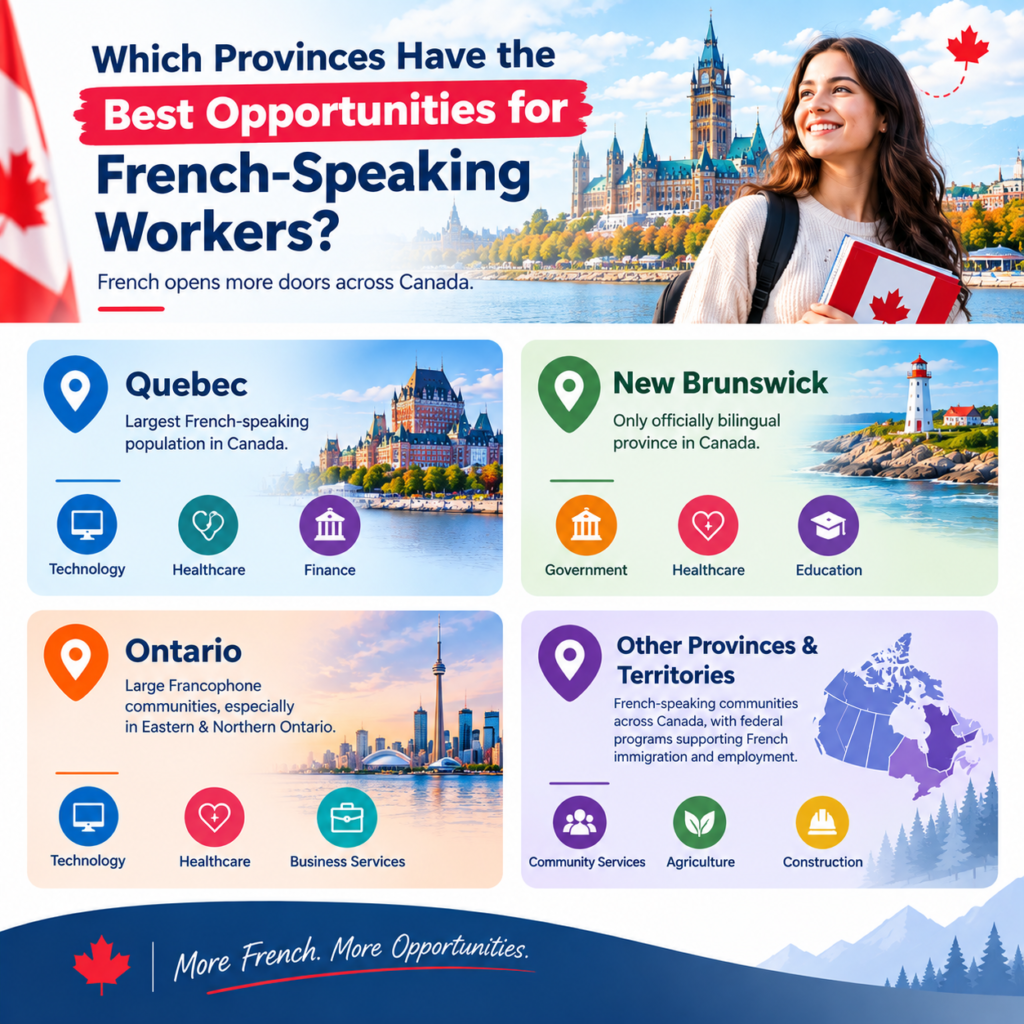
Which Provinces Have the Best Opportunities for French-Speaking Workers?
Quebec
Quebec has the largest French-speaking population in Canada and offers a wide range of French-language employment opportunities.
Montreal, Quebec City, and other communities provide opportunities across technology, finance, healthcare, education, government, manufacturing, and professional services.
New Brunswick
New Brunswick is Canada’s only officially bilingual province and has significant French-speaking communities.
French can be valuable in government, healthcare, education, customer service, and other sectors.
Ontario
Ontario has a large Francophone population, particularly in parts of Eastern and Northern Ontario.
Ottawa is especially important because of the presence of federal government institutions.
Other Provinces and Territories
French-speaking communities exist throughout Canada, and the federal government actively supports French-speaking immigration and employment outside Quebec. Current federal programs include Francophone Mobility and initiatives designed to support Francophone communities outside Quebec.
How to Get a High-Paying Job Using French in Canada
Knowing French is only one part of building a successful career.
1. Develop Professional French
Focus on the vocabulary used in your industry.
For example:
Finance: banking, investment, and accounting terminology
Healthcare: medical and patient-care vocabulary
Technology: software, cybersecurity, and technical terminology
Sales: negotiation, presentations, and customer communication
Law: contracts, regulations, and legal terminology
Professional French can make a much bigger difference than simply being able to hold a casual conversation.
2. Obtain a Recognized French Test Result
If you are learning French for immigration purposes, you may need an approved language test.
Depending on the immigration program, tests such as TEF Canada or TCF Canada may be accepted.
Always check the current requirements of the specific immigration program before booking a test.
3. Combine French With Your Profession
One of the strongest ways to improve your career prospects is to combine French with another professional skill.
For example:
- French + IT
- French + Healthcare
- French + Finance
- French + Engineering
- French + Sales
- French + Education
- French + Communications
This gives you both a professional specialization and an additional language skill.
4. Search for Jobs That Specifically Require French
When searching for employment, look for job descriptions that mention:
- French required
- French language skills
- French-speaking customers
- French-language services
- French communication
- French proficiency
For federal government positions, carefully review the language profile because requirements can differ for reading, writing, and oral communication.
Can French Help With Canadian Immigration?
Yes. French can also be relevant to Canadian immigration.
The Government of Canada has immigration and work programs specifically supporting French-speaking workers outside Quebec.
For example, under Francophone Mobility, eligible employers outside Quebec can hire qualifying French-speaking foreign workers without an LMIA. Applicants generally need intermediate French speaking and listening ability equivalent to NCLC 5 or higher, along with the other program requirements.
French-language skills can also be relevant to Express Entry and other immigration pathways.
However, immigration requirements can change, so applicants should always check the current official requirements before making an application.
Does Speaking French Guarantee a Higher Salary?
No.
French is a valuable skill, but it does not automatically result in a higher salary.
Your earning potential will generally depend on:
- Your occupation
- Education
- Professional qualifications
- Work experience
- Location
- Employer
- Industry
- Level of French proficiency
- Responsibilities of the position
The biggest benefit of French may be access to additional employment opportunities, rather than an automatic salary increase.
Frequently Asked Questions
Q1. What are the highest-paying French-speaking jobs in Canada?
Ans. Some strong career options include translation and interpretation, federal government positions, sales and account management, legal and compliance careers, healthcare, international relations, communications, and management.
Salary depends on the specific occupation, experience, location, and employer.
Q2. Is French useful for getting a job in Canada?
Ans. Yes. French can be valuable for positions that serve French-speaking customers and communities or require communication in both official languages. It can also be useful for certain federal government positions.
Q3. Which province is best for French-speaking jobs?
Ans. Quebec has the largest French-speaking employment market, but opportunities also exist in New Brunswick, Ontario, and other parts of Canada.
Q4. Can I work in Canada outside Quebec if I speak French?
Ans. Yes. Canada has programs designed to support French-speaking workers outside Quebec. The Francophone Mobility program, for example, can allow eligible French-speaking foreign workers to obtain a work permit for employment outside Quebec.
Q5. What level of French do I need to work in Canada?
Ans. It depends on the job. Some positions require basic French, while others require advanced professional communication.
Federal government positions can specify separate requirements for reading, writing, and oral interaction.
Q6. Can learning French increase my salary in Canada?
Ans. It can improve your access to certain jobs, but it does not guarantee a higher salary. Your occupation, qualifications, and experience remain major factors in determining your income.
Q7. Is French useful for Canadian immigration?
Ans. Yes. French can be relevant to several Canadian immigration and work pathways, including programs supporting French-speaking workers outside Quebec.
Q8. Which French test is accepted for Canada?
Ans. For immigration purposes, TEF Canada and TCF Canada are among the recognized French-language tests. The correct test depends on the immigration program you are applying under.
Q9. Can I get a government job in Canada with French?
Ans. Yes, depending on the position and your qualifications. Some federal government positions require French and English, with specific proficiency levels for reading, writing, and oral interaction.
Q10. Is learning French worth it for a career in Canada?
Ans. For many professionals, yes. French can expand the range of jobs they can consider and may be particularly useful in government, healthcare, finance, customer service, communications, education, and other sectors.
Final Thoughts
French can be a powerful career skill in Canada, especially when combined with professional education and work experience.
It can help you access French-language employment opportunities, serve a wider range of customers, work with Francophone communities, and qualify for certain positions where French is a job requirement.
If you are planning to work or immigrate to Canada, consider developing French alongside your professional skills. The combination of strong French proficiency + a recognized profession + Canadian-relevant experience can create a much stronger career profile.
Rather than learning French only for everyday communication, focus on developing the ability to speak, read, and write French confidently in a professional environment.
