

French has become an important strategy for skilled workers planning to immigrate to Canada through Express Entry. While many candidates focus mainly on improving their English score or gaining more work experience, strong French-language skills can open another opportunity through Express Entry category-based selection.
In 2026, French-language proficiency remains one of the categories used by Immigration, Refugees and Citizenship Canada (IRCC). Candidates who meet the French-language requirements can be considered for French-language proficiency draws if they are also eligible for an Express Entry program.
This is why following a French Express Entry draw tracker in 2026 can be useful. It allows candidates to compare their CRS score with previous French-language invitation rounds and understand how competitive their profile may be.
However, there is an important point to remember: there is no fixed CRS cutoff for French Express Entry draws. The score can change from one round to another depending on the number of invitations, the eligible candidates in the pool, and the instructions issued by IRCC.
French Express Entry Draw Tracker 2026
The best source for tracking Express Entry draws is IRCC’s official rounds-of-invitations information.
IRCC publishes important details about invitation rounds, including the date, round type, number of invitations, and CRS score of the lowest-ranked candidate invited.
For example, IRCC’s published 2026 ministerial instructions show a French-language proficiency round on May 28, 2026.
The published results were
| Detail | Result |
| Draw date | May 28, 2026 |
| Draw type | French-language proficiency |
| Invitations issued | 4,500 |
| CRS cutoff | 409 |
This result is useful when looking at the 2026 French Express Entry trend. However, 409 should not be treated as a permanent French draw cutoff.
The CRS threshold belongs specifically to that invitation round. A future French-language draw could have a higher or lower cutoff.
Candidates should therefore track several official draws instead of relying on one number.
What Does the CRS Cutoff Mean?
The CRS cutoff is the score of the lowest-ranked candidate who received an invitation in a particular Express Entry round.
For example, if IRCC conducts a French-language draw with a CRS cutoff of 409, it means the lowest CRS score among candidates invited in that round was 409.
It does not mean that everyone with 409 CRS will automatically receive an ITA in a future draw.
The cutoff can change because IRCC may change the number of invitations issued or the timing and type of invitation round.
The candidates in the Express Entry pool can also change over time.
This is why historical CRS cutoffs are best used as a benchmark rather than a guarantee.
What CRS Score Do You Need for a French Draw?
There is no single CRS score that guarantees an invitation through a French-language draw in 2026.
Instead, candidates should compare their current score with recent French-language draw results.
For example, imagine your CRS score is 420.
If recent French-language cutoffs have been around 400–415, your score may look competitive based on historical results.
But if the next draw has a cutoff of 425, your 420 score would not be enough for that particular round.
This is why candidates should avoid statements such as
“You only need 409 CRS for French Express Entry.”
That would be misleading.
A more accurate statement is
“A French-language draw had a CRS cutoff of 409 on May 28, 2026, but future cutoffs can change.”
What French Level Is Required?
One of the most important requirements for the French-language proficiency category is achieving NCLC 7 or higher in all four French-language abilities.
These four abilities are
- Speaking
- Listening
- Reading
- Writing
You cannot qualify for the French-language category simply by having strong conversational French.
For example, if you achieve NCLC 8 in speaking and listening but only NCLC 6 in reading, you would not meet the NCLC 7 requirement in all four abilities.
This is why candidates preparing for French-language Express Entry should prepare for the complete language test.
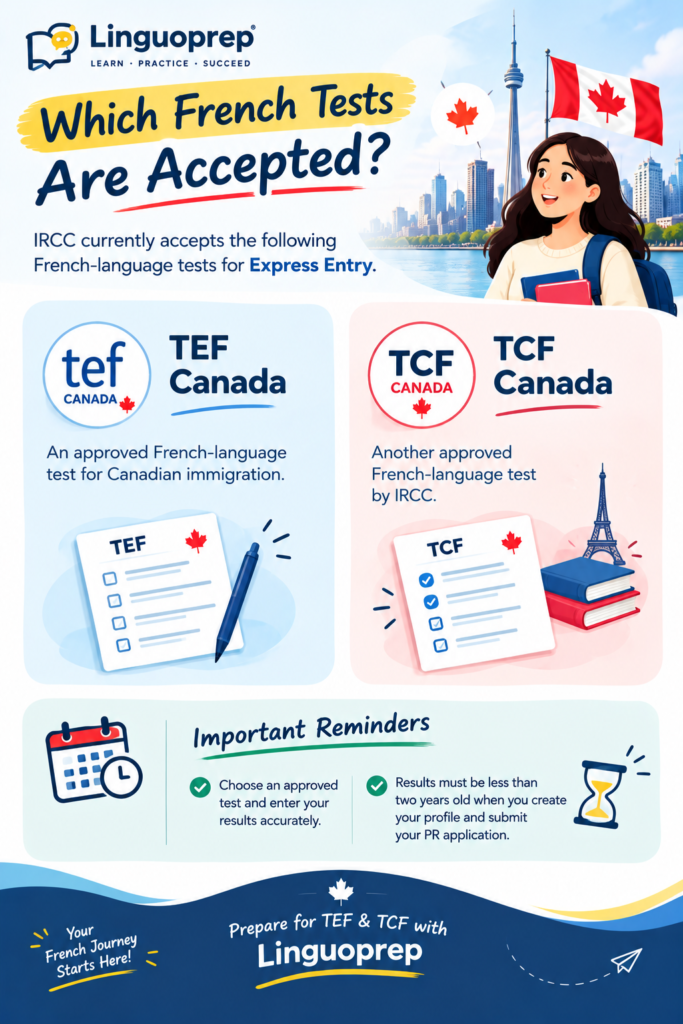
Which French Tests Are Accepted?
IRCC currently accepts the following French-language tests for Express Entry:
TEF Canada
TEF Canada is an approved French-language test that can be used to demonstrate French ability for Canadian immigration purposes.
TCF Canada
TCF Canada is another approved French-language test accepted by IRCC.
Candidates should choose an approved test and make sure their results are entered accurately in their Express Entry profile.
IRCC also requires language test results to generally be less than two years old when the Express Entry profile is created and when the permanent residence application is submitted.
Candidates should therefore monitor the expiry date of their language test.
How French Can Increase Your CRS Score
French speakers can benefit from Express Entry candidates in addition to category-based selection.
Under the current CRS rules, candidates can receive additional CRS points for strong French-language ability.
There are two levels.
25 Additional CRS Points
A candidate can receive 25 additional CRS points if they have NCLC 7 or higher in all four French abilities and meet the applicable English-language condition for the 25-point level.
This includes having CLB 4 or lower in English in all four abilities or not taking an English test.
50 Additional CRS Points
Candidates can receive 50 additional CRS points if they have:
- NCLC 7 or higher in all four French abilities, and
- CLB 5 or higher in all four English abilities.
This is important because candidates with both strong English and strong French may receive a larger additional CRS benefit.
These additional points are separate from the language points that form part of the core CRS calculation.
French Draws and French CRS Points Are Not the Same Thing
This distinction is often misunderstood.
There are two separate advantages associated with French.
First, qualifying French ability can give you additional CRS points.
Second, meeting the French-language proficiency requirement can make you eligible for consideration in a French-language category-based Express Entry round.
These are connected, but they are not the same benefit.
For example, a candidate may receive additional CRS points for French but still need to meet all the requirements of an Express Entry program.
Likewise, being eligible for the French category does not guarantee an ITA.
The candidate must still rank high enough in the specific invitation round.
French Draw vs. Generalized Express Entry Draw
A general Express Entry draw and a French-language draw work differently.
| Feature | General Draw | French-Language Draw |
| Selection type | General | Category-based |
| CRS ranking | Yes. | Yes. |
| French requirement | No specific French category requirement | NCLC 7 in all four abilities |
| Express Entry eligibility | Required | Required |
| Cutoff | Varies | Varies |
| ITA guaranteed? | No | No |
A French-language draw can have a different CRS cutoff because the eligible candidate group is different from the group considered in a general round.
This is one reason French can be useful for candidates whose CRS is not competitive enough in general draws.
Why Can French Draw Cutoffs Be Lower?
Category-based selection allows IRCC to focus on specific groups of candidates that meet particular economic or demographic priorities.
French-language proficiency is one of those categories.
Because the eligible group is narrower than the entire Express Entry pool, the CRS cutoff in a French-language round can differ significantly from a general round.
However, this should not be interpreted as meaning that French candidates automatically receive ITAs with low CRS scores.
Candidates still need to meet the category requirements and rank high enough among other eligible candidates.
How to Read a French Express Entry Draw Tracker
A draw tracker becomes more useful when you look at several factors together.
Suppose recent French-language draws showed:
| Draw | CRS Cutoff |
| Draw 1. | 405 |
| Draw 2. | 412 |
| Draw 3. | 409 |
| Draw 4. | 415 |
A candidate with a CRS of 420 would have been above each of these historical cutoffs.
That may look positive, but it still does not guarantee selection in the next draw.
The next cutoff could move higher or lower.
When following the tracker, look at:
- Number of invitations
- CRS cutoff
- Date of the draw
- Type of round
- Frequency of French-language rounds
- Your own CRS score
The purpose of a draw tracker is to help you understand the recent pattern, not predict the exact next cutoff.
What Is the Tie-Breaking Rule?
The CRS cutoff is not the only detail that can matter.
When multiple candidates have the same CRS score as the lowest-ranked invited candidate, IRCC can apply a tie-breaking rule based on the date and time their Express Entry profile was submitted.
For example, if the CRS cutoff is 409 and more eligible candidates have 409 than there are remaining invitations, the tie-breaking rule can determine which candidates receive an ITA.
The tie-breaking rule does not give additional CRS points. It is simply used to determine which candidates at the cutoff are included when necessary.
What If Your CRS Is Below the Latest French Cutoff?
Don’t assume that your Express Entry opportunity is over.
Your CRS profile can change.
Depending on your circumstances, possible ways to improve your ranking may include:
- Improving French-language results
- Improving English-language results
- Gaining additional eligible work experience
- Completing additional education
- Obtaining a provincial nomination if eligible
- Updating your Express Entry profile when your circumstances change
For some candidates, French may be one of the more realistic ways to improve their score.
For others, improving English or gaining additional work experience may make more sense.
The right strategy depends on your complete profile.
Why NCLC 7 Is an Important Target
Candidates who want to use French for category-based Express Entry selection should understand that NCLC 7 is not simply a speaking target.
It applies to all four abilities.
You should therefore prepare for:
Speaking
Work on fluency, vocabulary, pronunciation, and your ability to express ideas clearly.
Listening
Practise understanding conversations, different speakers, and natural French speech.
Reading
Build vocabulary and practice understanding written information quickly and accurately.
Writing
Work on grammar, organization, vocabulary, and your ability to communicate ideas clearly.
A balanced preparation strategy is important because a weak result in one ability can prevent you from meeting the required level across all four skills.
Is Learning French Worth It for Express Entry in 2026?
For some candidates, French can be a very valuable immigration strategy.
It can potentially provide:
Additional CRS points + eligibility for French-language category-based selection.
This makes French particularly interesting for candidates who already have a strong English foundation but need another way to strengthen their Express Entry profile.
However, learning French to NCLC 7 is not an overnight process.
Candidates should consider their current French level, available preparation time, and target immigration timeline before making a decision.
If you are already close to the required level, targeted preparation may be more practical than starting from the beginning.
How to Build a French Express Entry Strategy
If French is part of your Canada PR plan, consider the following steps.
1. Calculate Your Current CRS
Start by calculating your current CRS score using your age, education, language results, work experience, and other applicable factors.
2. Assess Your French Level
Check your ability in speaking, listening, reading, and writing.
Identify which skills need the most improvement.
3. Choose TEF Canada or TCF Canada.
Both are accepted by IRCC for Express Entry.
Understand the test structure before beginning intensive preparation.
4. Target NCLC 7 in All Four Abilities
Don’t prepare only for speaking.
Your target for the French category is NCLC 7 or higher in all four abilities.
5. Monitor Official Draw Results
Follow IRCC’s official invitation rounds and record the French-language CRS cutoff, number of invitations, and draw date.
6. Keep Your Profile Updated
If your language results, education, work experience, or other circumstances change, make sure your Express Entry profile reflects your current situation.
Final Thoughts
The French Express Entry Draw Tracker 2026 can be a useful tool for candidates planning their Canada PR strategy.
The most important thing to remember is that there is no permanent French-language CRS cutoff.
For example, IRCC recorded a French-language proficiency draw on May 28, 2026, with 4,500 invitations and a CRS cutoff of 409. That is an actual historical result, but it does not guarantee that the next French draw will have the same cutoff.
Candidates targeting the French-language category generally need NCLC 7 or higher in speaking, listening, reading, and writing, along with eligibility for an Express Entry program.
French can also provide 25 or 50 additional CRS points, depending on the candidate’s English results.
For someone whose CRS is close to the competitive range, those additional points can make French an important part of their immigration strategy.
The best approach is not to chase one particular CRS number. Instead, build the strongest profile you can, achieve the required French level, maintain valid language results, and monitor official IRCC invitation rounds.
Frequently Asked Questions
Q1. What is a French Express Entry draw?
Ans. It is a category-based Express Entry invitation round for candidates who meet IRCC’s reading and French-language proficiency requirements and are eligible for an Express Entry program.
Q2. What French level is required for the French-language category?
Ans. Candidates need NCLC 7 or higher in all four French abilities: speaking, listening, reading, and writing.
Q3. What was the French Express Entry CRS cutoff on May 28, 2026?
Ans. The cutoff was 409, and IRCC issued 4,500 invitations in that French-language proficiency round.
Q4. Is 409 CRS enough for a future French draw?
Ans. Not necessarily. The 409 cutoff applied to that specific round. Future CRS cutoffs can change.
Q5. How many CRS points can French add?
Ans. Depending on your English-language results, qualifying French can provide 25 or 50 additional CRS points.
Q6. Can I qualify for the French category with NCLC 6?
Ans. No. The current French-language category requires NCLC 7 or higher in all four French abilities.
Q7. Which French tests are accepted for Express Entry?
Ans. IRCC accepts TEF Canada and TCF Canada as approved French-language tests for Express Entry.
Q8. Does French guarantee an ITA?
Ans. No. Candidates must meet Express Entry and category requirements and rank high enough in the particular invitation round.
Q9. How long are French test results valid?
Ans. Language test results generally need to be less than two years old when you create your Express Entry profile and when you submit your permanent residence application.
Q10. Should I learn French if my CRS score is low?
Ans. French may be a useful strategy if you can realistically reach NCLC 7 in all four abilities. It can potentially improve your CRS and make you eligible for French-language category-based selection.ion before making a final decision.
Start Your French Preparation with LinguoPrep.
Whether you are starting French from the beginning or already have some knowledge of the language, LinguoPrep can help you build your skills through focused practice, feedback, and structured preparation.
Prepare smarter. Improve your French. Work towards your Canada immigration language goals with LinguoPrep.
