

If you are preparing for the CELPIP test, you may have one question in the back of your mind: Does my accent affect my CELPIP score?
This is a common concern, especially among candidates who speak English with an Indian, Punjabi, Hindi, Chinese, French, Arabic, or other regional accent. Some test takers believe they need to sound Canadian or like a native English speaker to achieve a high score.
That is not the right way to approach CELPIP preparation.
Having an accent does not automatically mean you will receive a lower score. However, pronunciation, rhythm, intonation, and overall listenability are important parts of the CELPIP Speaking assessment. The key issue is whether your speech is clear and easy for the listener to understand.
So, instead of trying to completely remove your accent, you should focus on making your English clear, natural, and effective.
Let’s look at the most common myths and facts about accent and CELPIP.
What Is CELPIP?
The Canadian English Language Proficiency Index Program (CELPIP) is an English-language test that measures practical communication skills in English.
The CELPIP-General test assesses four abilities:
- Listening
- Reading
- Writing
- Speaking
For many candidates, the speaking section is the most stressful because responses have to be given within a limited amount of time.
You need to communicate your ideas clearly while responding appropriately to different situations.
CELPIP’s Speaking assessment considers four main areas:
- Content and Coherence
- Vocabulary
- Listenability
- Task Fulfillment
Listenability is particularly relevant when discussing accent because it includes aspects such as pronunciation, rhythm, intonation, pauses, and other features of spoken delivery.
This means your goal should not be to sound like a particular nationality. Your goal should be to communicate successfully.
Does Your Accent Affect Your CELPIP Score?
The short answer: Your accent itself is not the same as poor pronunciation.
Everyone has an accent. Even native English speakers from Canada, the United States, the United Kingdom, and Australia do not all sound the same.
A candidate can have a noticeable accent and still speak English clearly and effectively.
For CELPIP, the more important question is whether your pronunciation and delivery make your message easy to understand.
For example, imagine two candidates.
Candidate A has a strong regional accent but speaks clearly, uses appropriate vocabulary, organizes ideas well, and maintains a natural rhythm.
Candidate B has a relatively neutral accent but frequently speaks too quickly, drops word endings, and is difficult to understand.
The second candidate may have greater listenability problems even though their accent sounds less noticeable.
This is why accent and intelligibility should not be treated as the same thing.
Myth 1: You Need a Canadian Accent to Get a High CELPIP Score
❌ Myth
You need to sound Canadian to achieve a high CELPIP Speaking score.
✅ Fact
You do not need to adopt a Canadian accent.
CELPIP evaluates your ability to communicate in English. You should focus on pronunciation and delivery rather than trying to copy a particular national accent.
If your natural accent is Indian, for example, you don’t need to completely change it.
Instead, work on:
- Clear pronunciation
- Word stress
- Sentence stress
- Natural rhythm
- Intonation
- Appropriate pauses
These improvements can make your speech easier to understand without changing who you sound like.
Myth 2: An Indian Accent Automatically Means a Lower Score
❌ Myth
Candidates with an Indian accent cannot achieve a high CELPIP score.
✅ Fact
Your natural accent does not automatically determine your CELPIP result.
India has many languages and regional varieties of English, so Indian English can sound different from Canadian English. That difference alone does not mean that communication is ineffective.
The important question is whether the listener can understand your message.
If your speech is clear and your response demonstrates strong vocabulary, grammar, organization, and task fulfillment, having an Indian accent does not automatically prevent you from achieving a strong result.
Instead of asking:
“How can I remove my Indian accent?”
Ask:
“How can I make my English clearer?”
That is a much more useful question during CELPIP preparation.
Myth 3: Good Pronunciation Means Sounding Like a Native Speaker
❌ Myth
You must sound like a native English speaker to get a high score.
✅ Fact
Pronunciation is much more than accent.
It includes the way you produce sounds, but also:
- Word stress
- Rhythm
- Intonation
- Pausing
- Speech flow
- Overall clarity
A person can have a strong accent and still have good pronunciation.
For example, if you pronounce words clearly and use appropriate stress and intonation, your speech can remain easy to understand even if your accent is noticeable.
Therefore, don’t spend your preparation trying to sound exactly like a Canadian speaker.
Focus on intelligible English.
Myth 4: Speaking Faster Will Increase Your Score
❌ Myth
The faster you speak, the higher your CELPIP score will be.
✅ Fact
Speaking quickly does not automatically demonstrate a high level of English.
In fact, speaking too fast can create problems.
You may:
- Mispronounce words
- Lose grammatical accuracy
- Repeat yourself
- Use too many fillers
- Forget important details
- Make your response difficult to follow
A comfortable, controlled pace is usually a better approach.
Your goal should be to speak naturally while giving yourself enough time to pronounce important words clearly.
Clarity is more important than unnecessary speed.
Myth 5: One Pronunciation Mistake Can Ruin Your Score
❌ Myth
If you mispronounce a word during your speaking test, your score will automatically drop.
✅ Fact
One small mistake does not define your entire speaking performance.
Language learners, and even highly proficient speakers, can make occasional mistakes.
The bigger issue is whether pronunciation problems are frequent or significant enough to interfere with communication.
If you make a mistake, don’t freeze.
Correct yourself if necessary and continue with your response.
Your ability to maintain communication is more important than trying to produce every sentence perfectly.
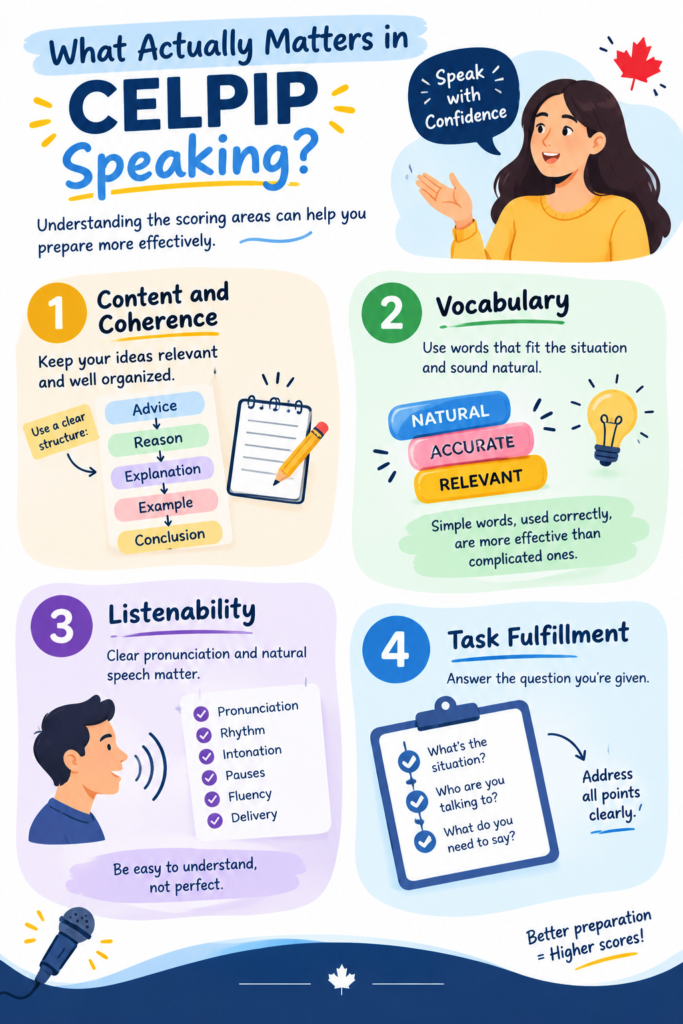
What Actually Matters in CELPIP Speaking?
Understanding the scoring areas can help you prepare more effectively.
1. Content and Coherence
Your ideas should be relevant and logically organized.
Don’t simply give a list of sentences.
For example, if you are asked to give advice, you can structure your response around:
Advice → Reason → Explanation → Example → Conclusion
This gives your answer a clear direction.
2. Vocabulary
You should demonstrate that you can use vocabulary appropriate to the situation.
That does not mean you need to use complicated words in every sentence.
Using an advanced word incorrectly can be less effective than using a simpler word accurately.
Focus on vocabulary that helps you express your ideas naturally and precisely.
3. Listenability
This is where pronunciation becomes particularly important.
CELPIP considers features such as
- Pronunciation
- Rhythm
- Intonation
- Pauses
- Fluency
- Speech delivery
If your speech is difficult to understand because of pronunciation problems, your performance can be affected.
The solution is not necessarily to eliminate your accent.
Instead, improve the features of your speech that interfere with understanding.
4. Task Fulfillment
Answer the question you were actually given.
Before speaking, quickly identify:
What is the situation?
Who am I speaking to?
What do I need to communicate?
Then develop your response around those points.
A candidate with good English can still give a weaker response if they do not properly address the task.
Accent vs. Pronunciation: Know the Difference
This distinction is extremely important for CELPIP candidates.
| Accent | Pronunciation |
| The characteristic way a person speaks | How clearly English sounds are produced |
| Influenced by language and regional background | Can be improved with practice |
| Everyone has an accent. | Everyone can improve pronunciation. |
| Does not automatically mean unclear speech | Can affect understanding if problems are frequent |
| Does not need to be completely removed | Should be clear enough for effective communication |
So, your goal should not be “remove my accent.”
Your goal should be
“Make my speech easy to understand.”
How to Improve Your Pronunciation for CELPIP
You can improve your spoken English without trying to completely change your accent.
Record Yourself
Record your speaking practice and listen to it afterward.
Check:
- Am I speaking too quickly?
- Are my words clear?
- Do I pronounce final sounds?
- Do I pause naturally?
- Do I repeat the same fillers?
This can help you identify problems you may not notice while speaking.
Practice Word Stress
Learn which syllables receive emphasis in commonly used words.
Correct stress can make your speech easier to understand and sound more natural.
Work on Difficult Sounds
Identify the sounds that cause you the most difficulty.
Some English learners struggle with sounds such as
- r/l
- v/w
- th
- Short and long vowels
- Final consonants
Practice these sounds in individual words and then use them in complete sentences.
Practice Rhythm and Intonation
Listen to natural English and notice how speakers emphasize important words, pause between ideas, and change their tone.
Then try to incorporate those patterns into your own speaking.
Try Shadowing.
Listen to a short section of English audio and repeat it immediately afterward.
Focus on:
- Rhythm
- Stress
- Pauses
- Intonation
- Pronunciation
You are not trying to copy the person’s identity or accent. You are practicing natural spoken-English patterns.
What If People Often Ask You to Repeat Yourself?
If people regularly ask you to repeat what you said, it may be worth working on your pronunciation or speaking clarity.
But don’t automatically blame your accent.
The problem could be:
- Speaking too quickly
- Low volume
- Unclear word endings
- Incorrect word stress
- Weak vowel sounds
- Too many fillers
- Unclear sentence delivery
Once you identify the specific problem, you can work on it much more effectively.
5 Simple Tips for Better CELPIP Speaking
1. Don’t Rush
A controlled pace is better than speaking extremely quickly.
2. Speak Clearly
Pay attention to important sounds and word endings.
3. Organize Your Ideas
Know what you want to say before you start developing your response.
4. Use Natural Vocabulary
Choose words you can use accurately and confidently.
5. Don’t Panic About Your Accent
Your objective is effective communication, not perfect imitation of another accent.
Final Verdict: Does Accent Affect CELPIP Score?
So, does your accent affect your CELPIP score?
Having an accent does not automatically result in a lower score. You do not need to sound Canadian or like a native English speaker.
However, pronunciation, rhythm, intonation, and overall listenability are part of the speaking assessment. If pronunciation difficulties regularly make your speech difficult to understand, they can affect your performance.
That’s why the best approach is not to eliminate your natural accent.
Instead, focus on:
- Clear pronunciation
- Natural rhythm
- Appropriate intonation
- Comfortable speaking speed
- Effective pauses
- Strong vocabulary
- Accurate grammar
- Organized ideas
- Task fulfillment
- Confident delivery
Your accent is part of how you speak. Clarity is what you should train.
If you are preparing for CELPIP, don’t try to become someone else. Work on making your English clear, natural, and easy to understand. That is a much more practical goal—and a better way to approach your speaking preparation.
Related Links
- CELPIP Reading Strategies That Actually Work
- CELPIP Listening Tips to Improve Score Fast
- CELPIP Listening Tricks That Actually Work
- CELPIP Speaking Topics With Sample Answers
- Common CELPIP Mistakes Indian Students Make in 2026
Frequently Asked Questions About Accent and CELPIP
Q1. Does having an accent affect my CELPIP score?
Having an accent does not automatically lower your CELPIP score. CELPIP Speaking evaluates factors such as pronunciation, rhythm, intonation, vocabulary, content, and task fulfillment. The key is whether your speech is clear and easy to understand.
Q2. Do I need a Canadian accent to get a high CELPIP score?
No. You do not need to copy a Canadian accent. Focus on clear pronunciation, natural rhythm, appropriate intonation, and a comfortable speaking pace.
Q3. Can an Indian accent affect my CELPIP speaking score?
An Indian accent by itself does not mean you will receive a lower score. However, pronunciation or speech patterns that regularly make your responses difficult to understand can affect the listenability of your performance.
Q4. What does CELPIP look for in pronunciation?
CELPIP considers pronunciation as part of the broader listenability dimension. This includes how easily the listener can understand your speech, along with factors such as rhythm, pronunciation, intonation, pauses, and overall speech delivery.
Q5. Should I speak faster to get a higher CELPIP score?
No. Speaking quickly does not automatically result in a higher score. Speaking too fast can actually make your pronunciation less clear and increase mistakes. A controlled and natural pace is generally better.
Q6. Can pronunciation mistakes lower my CELPIP score?
Occasional pronunciation mistakes do not necessarily mean you will receive a low score. What matters is the overall quality and understandability of your speaking performance. Frequent problems that interfere with communication can affect listenability.
Q7. How can I improve my pronunciation for CELPIP?
You can improve by recording yourself while speaking, practicing difficult English sounds, learning correct word stress, working on rhythm and intonation, and listening to natural English speakers. Regular speaking practice can also improve confidence and fluency.
Q8. What is more important: accent or pronunciation in CELPIP?
Pronunciation and overall listenability are more important than trying to eliminate your natural accent. You do not need to sound like a native speaker. Your goal should be to make your English clear, understandable, and natural.
Q9. How can I make my CELPIP Speaking responses easier to understand?
Avoid rushing, pronounce words clearly, use natural pauses, organize your ideas, and maintain appropriate rhythm and intonation. Practicing complete responses instead of individual words can also help improve overall delivery.
Q10. What is the biggest mistake candidates make about accents in CELPIP?
One common mistake is spending too much time trying to change their accent instead of improving clarity. CELPIP candidates should focus on communicating their ideas effectively while maintaining clear pronunciation, natural rhythm, and understandable speech.
