

Achieving CLB 9 in CELPIP can be an important goal for candidates preparing for Canadian permanent residence through Express Entry. However, reaching this level requires more than learning English vocabulary or completing practice tests every day. You need to understand the test format, identify your weaknesses, and develop a strategy for each section.
The CLB 9 Roadmap 2026 focuses on improving listening, reading, writing, and speaking through targeted practice, time management, and regular performance reviews.
For CELPIP-General, a CELPIP level of 9 corresponds to CLB 9 in the same ability. Since the test reports separate results for all four skills, you should prepare for each section individually rather than relying on one overall performance estimate.
In this guide, you will learn how to assess your current level, improve each section, and create a practical preparation routine for your target score.
What Does CLB 9 Mean in CELPIP?
CLB stands for Canadian Language Benchmarks, a system used to describe English language proficiency for Canadian immigration and other purposes.
For CELPIP-General, the corresponding score for CLB 9 is CELPIP level 9 in each ability you need to meet that benchmark.
Your four targets are:
- Listening: CELPIP 9
- Reading: CELPIP 9
- Writing: CELPIP 9
- Speaking: CELPIP 9
CLB 9 is a useful target for many Express Entry candidates because higher language proficiency can improve CRS points and may contribute to additional skill-transferability points when the other eligibility conditions are met.
However, CLB 9 is not a universal minimum requirement for every immigration applicant. Check the requirements of your specific immigration program before deciding on your target.
Step 1: Start With a CELPIP Diagnostic Test
Before beginning your preparation, understand your current performance.
Take one realistic full-length CELPIP-General practice test under timed conditions. Complete all four sections without pausing to study between tasks.
Record your results and identify the question types where you lose the most marks.
For example:
| Section | What to review |
| Listening | Missed details, speaker opinions, and main ideas |
| Reading | Incorrect answers, paraphrasing, and time pressure |
| Writing | Task completion, organization, grammar, and vocabulary |
| Speaking | Idea development, clarity, fluency, and timing |
Your goal is to identify two or three recurring weaknesses that deserve the most attention.
Avoid taking multiple full mock tests without reviewing your mistakes. A diagnostic test is valuable only when you use its results to improve your next attempt.
Step 2: CELPIP Listening Strategy for CLB 9
The listening section tests your ability to understand conversations, information, opinions, and discussions in different situations.
To target CELPIP level 9, focus on understanding the overall message as well as the details that support it.
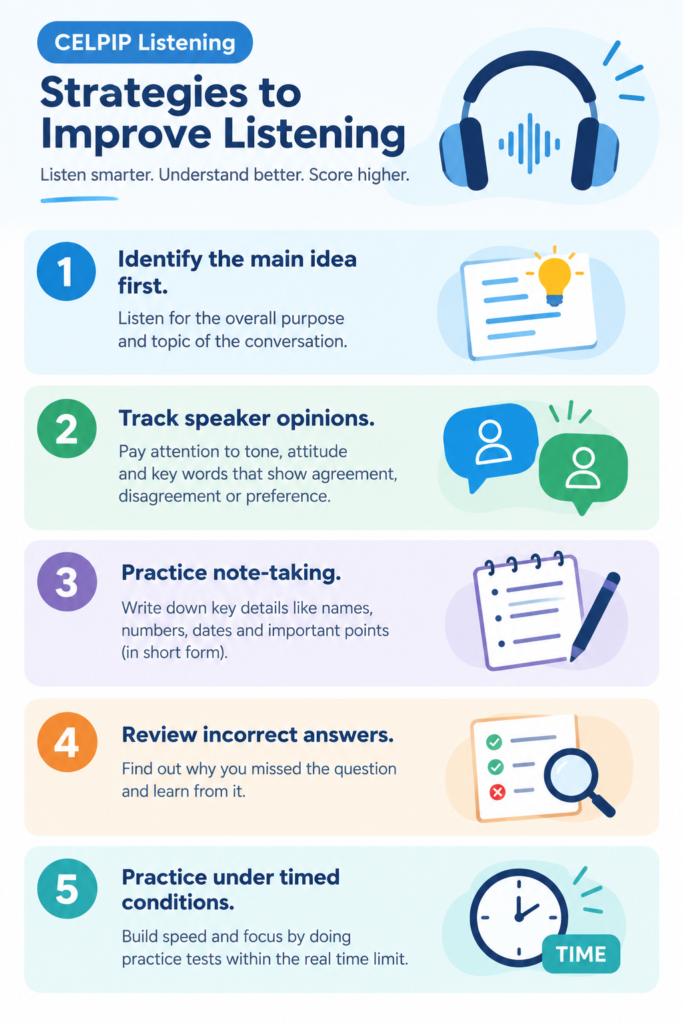
Strategies to improve listening
1. Identify the main idea first.
Listen for the purpose of the conversation. Ask yourself what the speakers are discussing and why the conversation is taking place.
2. Track speaker opinions
Some questions require you to understand a speaker’s attitude, preference, or reason for making a decision. Pay attention to changes in tone and expressions that indicate agreement, disagreement, or uncertainty.
3. Practice note-taking.
Write down short keywords, names, numbers, reasons, and important details when useful. Avoid trying to record every sentence because this can distract you from the recording.
4. Review incorrect answers.
After each practice session, determine whether your mistake occurred because you missed a detail, misunderstood a phrase, or selected an answer that sounded correct but did not match the recording.
5. Practice under timed conditions. practice
Once you understand the question patterns, practice using the actual test timing.
Daily practice goal: Complete one focused listening practice set and spend time reviewing why each incorrect answer was wrong.
Step 3: CELPIP Reading Strategy for CLB 9
Reading requires you to understand written information, recognize relationships between ideas, and locate relevant details within a limited time.
A strong reading strategy combines comprehension with efficient use of time.
Strategies to improve reading
1. Read for meaning, not just keywords.
A question may use different words from the passage while expressing the same idea. Learn to recognize paraphrases and synonyms.
2. Identify the purpose of each paragraph.
Understand whether a paragraph introduces an idea, provides evidence, explains a problem, or presents a conclusion.
3. Use the question to guide your search.
Read the question carefully before looking for relevant information. This helps you focus on the details needed to answer it.
4. Practice difficult task types separately.
If you frequently struggle with information matching or paragraph relationships, practice those question types before returning to full reading tests.
5. Improve your pacing
Do not spend too much time on one difficult question. Make the best decision you can and manage your remaining time carefully.
Daily practice goal: Complete one reading task, review your incorrect answers, and record any unfamiliar vocabulary or paraphrasing patterns.
Step 4: CELPIP Writing Strategy for CLB 9
Writing can require focused preparation because you must communicate your ideas clearly while following the task instructions, organizing information, and controlling grammar.
CELPIP-General includes two writing tasks: writing an email and responding to a survey question.
Strategies to improve writing
1. Understand the task before writing.
Identify the audience, purpose, and required information. Your response should address the actual question rather than include memorized material that does not fit.
2. Organize your response logically
For an email, use a clear opening, organized paragraphs, and an appropriate closing. For a survey response, state your position and support it with relevant reasons and examples.
3. Develop your ideas
Do not simply list several points. Explain why each important point matters and include relevant supporting details.
4. Use vocabulary naturally. readability.
Choose words that communicate your meaning accurately. Complicated vocabulary is not useful if it makes your response unclear or unnatural.
5. Check grammar and readability.
Review sentence structure, verb tense, punctuation, spelling, and paragraph organization. Leave time for a brief final check.
6. Practice with feedback.
After completing a task, review whether you answered every part of the prompt and supported your main ideas sufficiently.
Daily practice goal: Complete one writing task on selected practice days and maintain an error log to track repeated problems.
Step 5: CELPIP Speaking Strategy for CLB 9
The Speaking section assesses how effectively you communicate ideas through structured spoken responses.
Candidates often lose effectiveness when they give very short answers, repeat the same ideas, speak without a clear structure, or rush because they have not practiced under timed conditions.
Strategies to improve speaking
1. Follow a clear response structure
Organize your answer into a beginning, supporting details, and a conclusion where appropriate.
2. Develop your ideas with examples.
When giving an opinion or recommendation, explain your reasons and add a relevant example instead of repeating the same point.
3. Practice speaking within the time limit.
Use a timer and respond to prompts without repeatedly restarting. Learn to organize your ideas quickly.
4. Focus on clear pronunciation.
Speak at a comfortable pace and pronounce words clearly. You do not need to imitate a particular accent to communicate effectively.
5. Use varied sentence structures.
Practise combining simple sentences with more complex structures while maintaining grammatical accuracy.
6. Record and review your answers.
Listen to your recordings and check whether your response is relevant, organized, understandable, and complete.
Daily practice goal: Complete one or two timed speaking tasks and identify one specific improvement for your next attempt.
Step 6: Follow a Four-Week CLB 9 Study Plan
A four-week plan can help organize your preparation, but the time needed to reach CLB 9 depends on your current proficiency and practice results. Four weeks should not be treated as a guaranteed preparation period.
Week 1: Diagnose and Identify Weaknesses
- Take a full diagnostic test.
- Review your performance in all four sections.
- Identify your two weakest task types.
- Begin focused practice on those tasks.
Week 2: Improve Accuracy
- Practice listening and reading question types separately.
- Complete regular writing and speaking exercises.
- Review mistakes and learn why they happened.
- Focus on accuracy before increasing speed.
Week 3: Build Timing and Consistency
- Complete timed practice sets.
- Practice answering without unnecessary pauses.
- Review writing and speaking practice for clarity and task completion.
- Revisit the weaknesses identified in Week 1.
Week 4: Simulate and Review
- Complete a full mock test under realistic conditions.
- Compare your performance with the initial diagnostic.
- Identify any remaining gaps.
- Complete another simulation if appropriate and use the results to plan further preparation.
If your results remain below CLB 9 in one or more sections, continue targeted practice rather than booking the test based only on your preparation schedule.
Common Mistakes to Avoid During CLB 9 Preparation
Your preparation becomes more effective when you focus on the quality of your practice rather than the number of questions completed.
Avoid these common problems:
- Taking full mock tests without reviewing errors.
- Memorizing speaking and writing answers without adapting them to the question.
- Learning advanced vocabulary without practicing its correct use.
- Ignoring your weakest section because another section feels easier.
- Spending too much time on one question during timed practice.
- Booking the exam without checking whether your performance is consistent.
The objective is to build skills that you can use across different questions, not simply memorize answers to familiar prompts.
How Linguoprep Can Help You Prepare for CLB 9
Preparing for CLB 9 becomes more manageable when you have a clear target, suitable practice material, and a structured routine.
At Linguoprep, candidates can explore preparation options for CELPIP, IELTS, PTE Core, and French language tests.
A focused CELPIP preparation plan should include practice for all four skills, timed exercises, regular mock tests, and a review of recurring mistakes. Candidates should also monitor their progress to determine when they are ready to attempt the official exam.
If your goal is to improve your English test performance for Canadian immigration, visit Linguoprep to explore language preparation options.
Frequently Asked Questions
Q1. What CELPIP score is equivalent to CLB 9?
Ans. CELPIP level 9 corresponds to CLB 9 in the same ability. If your immigration goal requires CLB 9 in all four English abilities, you should target level 9 in listening, reading, writing, and speaking.
Q2. How can I prepare for CLB 9 in CELPIP in 2026?
Ans. Start with a diagnostic test, identify your weakest task types, practice them individually, and gradually introduce timed exercises and full mock tests. Your preparation period should depend on your starting level and progress.
Q3. Which CELPIP section is the hardest?
Ans. There is no universally hardest section. Some candidates struggle with listening details, others with reading time management, writing organization, or speaking fluency. Your diagnostic results can help you determine where to focus.
Q4. Is CLB 9 necessary for Express Entry?
Ans. Not for every applicant. Minimum language requirements depend on the immigration program and other applicable rules. CLB 9 can be a valuable target for improving CRS points and potentially qualifying for additional skill-transferability points.
Q5. Can mock tests help me achieve CLB 9?
Ans. Yes. Realistic mock tests can help you understand the format, assess timing, and identify weaknesses. However, mock tests are most useful when you carefully review your errors and adjust your preparation accordingly.
Q6. How many hours should I study daily for CLB 9?
Ans. There is no fixed number of hours that guarantees CLB 9. Build a consistent routine around your current level, available time, and weakest skills. Focused practice and error review are more useful than studying for long hours without a clear plan.
Conclusion
The CLB 9 Roadmap 2026 begins with understanding your current performance and setting clear targets for each CELPIP section. Listening requires careful attention to meaning and details, reading requires efficient comprehension, writing requires organization and accurate language, and speaking requires clear, well-developed responses.
Use diagnostic tests to guide your preparation, practice difficult task types, and review your progress regularly. Once your results become consistent under realistic test conditions, you will have a stronger basis for deciding when to book your official CELPIP-General test.
For additional preparation support, explore the language learning resources available through Linguoprep.
