
If you are a permanent resident planning to apply for Canadian citizenship, you may be wondering what CELPIP score you actually need.
The answer is simpler than many applicants expect.
For eligible citizenship applicants aged 18 to 54, IRCC requires proof of language ability in English or French at Canadian Language Benchmark (CLB) 4 or higher. If you use CELPIP as your language proof, you generally need CELPIP level 4 or higher in both listening and speaking.
This is different from the language scores required for programs such as Express Entry. You do not need CELPIP 7 or CELPIP 9 simply to meet the Canadian citizenship language requirement.
What CELPIP Score Is Required for Canadian Citizenship?
For applicants who need to provide language proof, IRCC currently requires a minimum level of CLB 4.
For CELPIP, this means:
| Language ability | Minimum CELPIP level |
| Listening | 4 |
| Speaking | 4 |
| Reading | No separate minimum for the citizenship language requirement |
| Writing | No separate minimum for the citizenship language requirement |
The important point is that the required level applies to both listening and speaking.
For example, a CELPIP Listening score of 4 and a Speaking score of 4 meet the stated minimum. However, a listening score of 4 combined with a speaking score of 3 would not meet the minimum threshold.
IRCC’s citizenship instructions should always be checked before submitting an application because requirements and accepted evidence can change.
Who Needs to Meet the Citizenship Language Requirement?
The language requirement generally applies to citizenship applicants who are 18 to 54 years old when they apply.
Applicants in this age range need to demonstrate that they can communicate in English or French at CLB 4 or higher in speaking and listening.
Applicants may not necessarily need to take a new language test. IRCC accepts several forms of language proof, depending on the applicant’s circumstances.
For example, acceptable evidence can include certain educational documents showing that the applicant studied in English or French.
This means it is worth checking your existing documents before registering for another test.
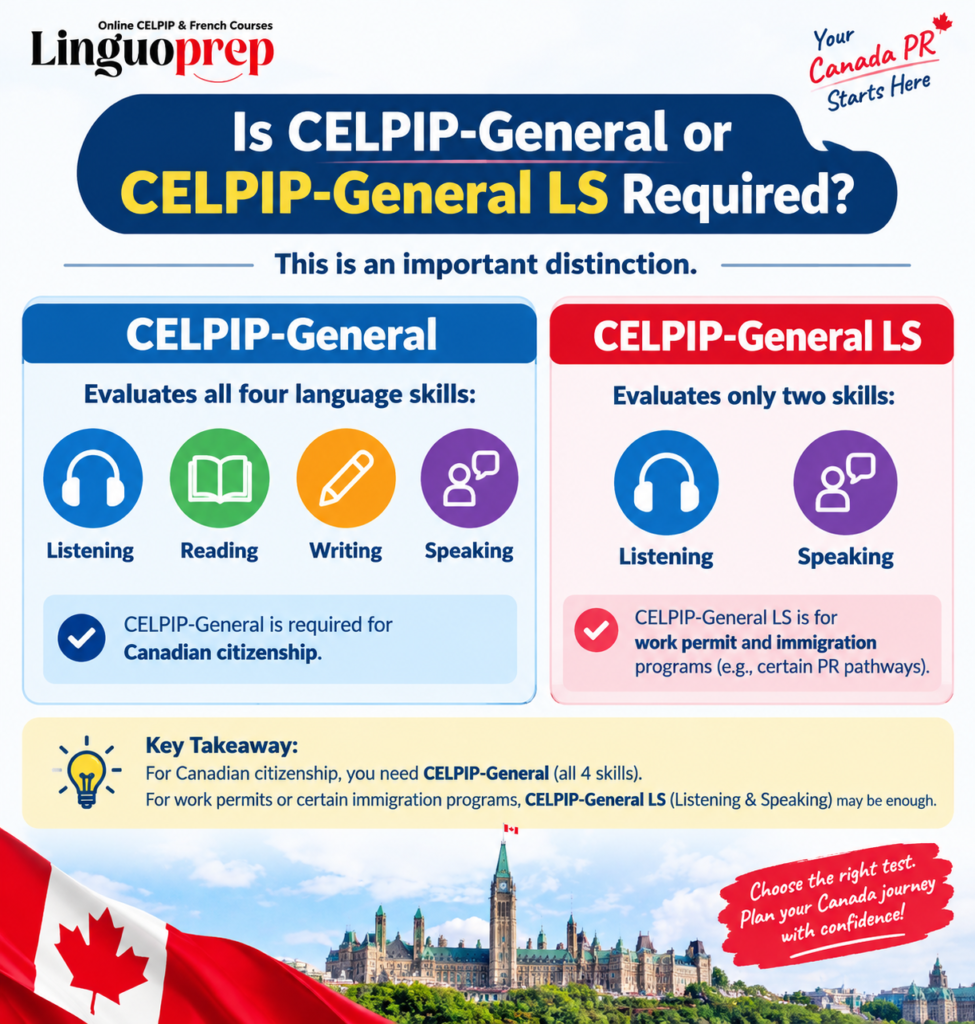
Is CELPIP-General or CELPIP-General LS Required?
This is an important distinction.
CELPIP-General evaluates:
- Listening
- Reading
- Writing
- Speaking
CELPIP-General LS evaluates:
- Listening
- Speaking
CELPIP-General LS is specifically designed for situations such as Canadian citizenship, where only listening and speaking are assessed.
IRCC’s citizenship language-proof requirements list qualifying results from CELPIP-General and CELPIP-General LS. For applicable CELPIP results, the required level is 4 or higher in listening and speaking.
However, the test you need depends on the purpose of your application. For example, Express Entry requires CELPIP-General, not CELPIP-General LS.
Therefore, applicants should make sure they register for the appropriate test rather than assuming that all CELPIP versions are interchangeable.
CELPIP for Citizenship vs. Express Entry
Many permanent residents become confused because they previously took CELPIP for immigration purposes.
The language requirement for Canadian citizenship is not the same as the language requirement for Express Entry.
For citizenship, eligible applicants generally need:
CLB 4 in Listening and Speaking
Express Entry has different minimum language requirements depending on the program.
For example, the Federal Skilled Worker Program generally requires CLB 7 in all four language abilities for the first official language.
Under the Canadian Experience Class, the minimum is generally
- CLB 7 for TEER 0 or 1 occupations
- CLB 5 for TEER 2 or 3 occupations
These are permanent residence requirements, not Canadian citizenship requirements.
Therefore, someone who previously prepared for CELPIP 7 or CELPIP 9 for Express Entry should not assume that the same score is required for citizenship.
Do You Need Reading and Writing for Citizenship?
For the CELPIP language-proof requirement, IRCC specifies the minimum results for listening and speaking.
This is why CELPIP-General LS can be particularly relevant to citizenship applicants.
The full CELPIP-General test includes reading and writing, but applicants should focus on the requirements that apply to their specific citizenship application.
The key citizenship threshold is
CELPIP 4 or higher in Listening + CELPIP 4 or higher in Speaking.
Can You Use an Old CELPIP Result?
This is another important difference between citizenship and some other immigration applications.
IRCC’s citizenship guidance states that qualifying CELPIP results taken on or after April 1, 2014, can be used as language proof if they meet the required level.
Importantly, IRCC indicates that qualifying test results may be accepted even if they are expired.
Therefore, if you previously completed CELPIP for another Canadian immigration application, do not automatically assume that you need to take the test again.
First, check the test date, score, and whether it meets the current citizenship language-proof requirements.
What If Your CELPIP Score Is Below 4?
If either your listening or speaking result is below the required level, you would not meet the CELPIP language threshold through that result.
For example:
| Listening | Speaking yes. | Meets the minimum? |
| 4 | 4 | Yes. |
| 5 | 4 | Yes. |
| 6 | 5 | Yes. |
| 4 | 3 | No |
| 3 | 4 | No |
The minimum needs to be met in both required abilities.
If you have another acceptable form of language proof, such as qualifying education documents, you may have another way to demonstrate your language ability.
Can You Use CELPIP Instead of IELTS?
Yes. CELPIP is one of the English-language tests recognized for Canadian citizenship language proof.
IRCC also accepts certain IELTS results for applicants who need to provide language evidence.
For citizenship, the applicable IELTS General Training requirement is different from the CELPIP requirement. IRCC currently lists 4.0 or higher in Speaking and 4.5 or higher in Listening for qualifying IELTS General Training results.
The important point is to use the current IRCC requirements for the test you are submitting.
What Other Language Proof Can Be Used?
A language test is not necessarily the only option.
Depending on your circumstances, IRCC may accept educational evidence as proof of English or French ability.
Examples can include:
- Diplomas
- Transcripts
- Certificates
- Other qualifying education documents
The documents must meet IRCC’s requirements. If your documents are in a language other than English or French, translation requirements may also apply.
Before booking a new CELPIP test, check whether you already have acceptable proof.
Is CELPIP 7 or 9 Better for Citizenship?
For the purpose of meeting the basic citizenship language requirement, the important threshold is CLB 4, not CELPIP 7 or 9.
A higher CELPIP result demonstrates a higher level of language ability, but applicants should not confuse a higher score with an additional citizenship requirement.
If your only objective is satisfying the citizenship language requirement, the relevant IRCC threshold is the one that applies to your citizenship application.
Your previous CELPIP score may also have been taken for a different purpose, such as Express Entry, where higher language levels can affect program eligibility or ranking.
Other Canadian Citizenship Requirements
Meeting the language requirement is only one part of becoming a Canadian citizen.
Eligible applicants must also satisfy the other applicable citizenship requirements. These can include:
- Physical presence in Canada
- Income tax filing requirements, where applicable
- Prohibitions
- Citizenship application requirements
- Citizenship knowledge test requirements
The language requirement does not replace the citizenship test or other eligibility conditions.
Applicants should review their complete circumstances before submitting an application.
Prepare for CELPIP with Linguoprep.
If you are preparing for CELPIP for Canadian citizenship, focusing on the required listening and speaking skills can help you approach the test with greater confidence.
Linguoprep provides language-test preparation support for learners preparing for CELPIP and other English-language tests. Whether you need help with speaking practice, listening strategies, mock tests, or understanding the test format, structured preparation can make your preparation more focused.
Prepare with Linguoprep and work toward the CELPIP score required for your Canadian immigration or citizenship plans.
Final Takeaway
For eligible Canadian citizenship applicants who need to provide language proof, the CELPIP requirement is straightforward:
CELPIP 4 or higher in Listening and Speaking.
You do not need CELPIP 7 or 9 simply to satisfy the citizenship language requirement.
Before applying, however, check whether you already have an acceptable language document or previous CELPIP result. Also remember that language ability is only one part of the Canadian citizenship application.
Because immigration and citizenship requirements can change, always verify the current requirements with IRCC before submitting your application.
FAQs
Q1. What CELPIP score is required for Canadian citizenship?
Ans. Eligible applicants who need language proof generally require CELPIP 4 or higher in Listening and Speaking.
Q2. Do I need CELPIP 7 for Canadian citizenship?
Ans. No. CELPIP 7 is not the general citizenship language threshold. The applicable minimum is CLB 4 in speaking and listening.
Q3. Is CELPIP-General LS accepted for Canadian citizenship?
Ans. Yes. IRCC lists qualifying CELPIP-General LS results as acceptable language proof for citizenship.
Q4. Can I use an expired CELPIP result?
Ans. Qualifying CELPIP results taken on or after April 1, 2014, may be accepted for citizenship even if expired, provided they meet the applicable requirements.
Q5. Do I need reading and writing for citizenship?
Ans. For the CELPIP citizenship language requirement, IRCC specifies the required results for listening and speaking.
Q6. Is CELPIP required for every citizenship applicant?
Ans. No. Applicants may be able to provide other acceptable forms of language proof, depending on their circumstances.
