If you are searching for the Canada SDS 2026 IELTS score, there is an important update you need to know before planning your study permit application.
The Student Direct Stream (SDS) is no longer available. Immigration, Refugees and Citizenship Canada (IRCC) ended the SDS on November 8, 2024. Applications submitted after the closure are processed under the regular study permit process.
However, the old SDS IELTS requirement continues to appear across websites and social media, creating confusion for students who see references to an overall IELTS 6.0.
The important distinction is between the former SDS language requirement, the current study permit process, and the language requirements set by Canadian colleges and universities.
What Happened to Canada SDS?
The Student Direct Stream was introduced to provide faster processing for eligible international students from specific countries, including India.
Under the former SDS rules, eligible applicants had to meet specific requirements, including financial and language requirements. For IELTS Academic, the previous SDS requirement included a minimum overall score of 6.0. Depending on the rules applicable at the time, other approved language tests were also available.
But this is now historical information.
IRCC officially ended SDS on November 8, 2024, at 2 p.m. ET. Since then, new applications have been processed through the regular study permit system.
Therefore, students applying in 2026 should not prepare their application as though SDS is still an available stream.
Does Overall IELTS 6.0 Still Matter for Canada in 2026?
An IELTS overall score of 6.0 can still be relevant to a student’s Canadian education plans, but it should not be described as the current SDS requirement.
The reason is that IELTS requirements can come from different sources:
- Your Canadian college or university
- Your specific program
- Your study permit application circumstances
- Other immigration programs you may later apply for
Canadian institutions set their own admission requirements. IDP notes that IELTS requirements can vary according to the institution and level of study, with many Canadian undergraduate programs requiring around 6.5 and postgraduate programs often requiring 6.5–7.0, although requirements vary by institution.
This means a student should not simply think:
“I have IELTS 6.0 overall, so I meet every Canada requirement.”
That is not necessarily the case.
Overall Band vs. Individual Section Scores
One of the biggest IELTS mistakes is focusing only on the overall band.
IELTS reports four individual scores:
- Listening
- Reading
- Writing
- Speaking
Your overall band is calculated from these four components.
For example, a student could have:
| IELTS Skill | Score |
| Listening | 7.0 |
| Reading | 6.5 |
| Writing | 5.5 |
| Speaking | 6.0 |
| Overall | 6.5 |
The overall score looks strong, but the writing score may still create a problem if the student’s institution requires a minimum of 6.0 in every section.
This is why students should always check both:
Overall IELTS requirement + minimum individual-band requirement.
IDP also emphasizes that IELTS requirements vary between institutions and that organizations may evaluate the four language skills individually.
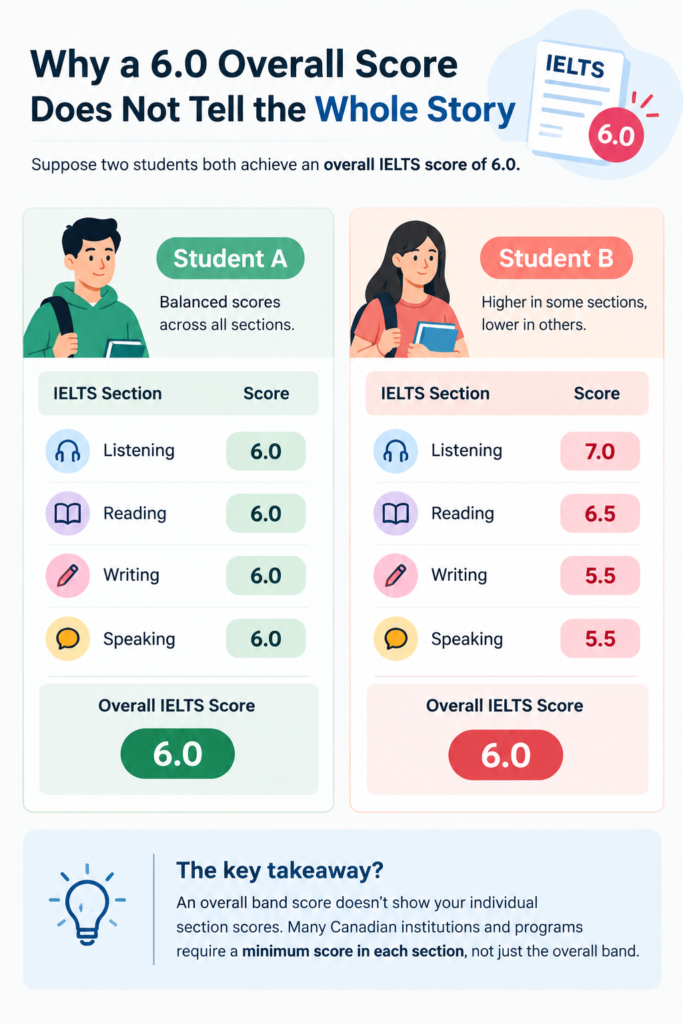
Why a 6.0 Overall Score Does Not Tell the Whole Story
Suppose two students both achieve an overall IELTS score of 6.0.
Student A
- Listening: 6.0
- Reading: 6.0
- Writing: 6.0
- Speaking: 6.0
Student B
- Listening: 7.0
- Reading: 6.5
- Writing: 5.5
- Speaking: 5.5
Both may have an overall result around 6.0, but their individual profiles are different.
If a college requires 6.0 in every component, Student B would not meet that institutional requirement.
This is why students should avoid treating the overall band as the only number that matters.
Canada Study Permit vs. College Admission
Another important distinction is between study permit requirements and admission requirements.
A college or university decides whether your English-language result satisfies its admission conditions.
The study permit application is a separate immigration process. IRCC evaluates the application based on the applicable study permit requirements and supporting evidence.
The current IRCC study permit process requires applicants to prepare documents such as their letter of acceptance and, where required, a provincial or territorial attestation letter.
Therefore, getting an IELTS score that satisfies a school’s admission requirement does not automatically guarantee study permit approval.
A complete application also needs to address the other relevant requirements, including financial support, the purpose of the study, and other supporting documentation applicable to the applicant.
What IELTS Score Should Students Target for Canada in 2026?
There is no single universal IELTS score that applies to every Canadian college, university, and program.
Your target should be based on the requirements of your chosen institution and program.
For example, IDP’s 2026 guidance lists general ranges around:
- Undergraduate: often around IELTS 6.5
- Postgraduate: often around IELTS 6.5–7.0
However, these are general ranges rather than a universal immigration requirement. Students should verify the exact requirement directly with their institution.
If your chosen institution requires 6.5 overall with no band below 6.0, preparing specifically for an overall 6.0 would not be enough.
What About IELTS 6.0 for the PGWP?
Students planning their entire Canadian journey should also understand that study permit language requirements and Post-Graduation Work Permit (PGWP) language requirements are separate.
For PGWP applications submitted on or after November 1, 2024, applicants generally need to demonstrate English or French language ability in all four skills.
For graduates of bachelor’s, master’s, and doctoral programs, the current requirement is CLB 7 or NCLC 7 in all four language abilities. For graduates of other university programs and eligible college/polytechnic/non-university programs, the requirement is generally CLB 7 or CLB 5, respectively, depending on the program category.
IRCC accepts specific language tests for PGWP purposes, including
- IELTS General Training
- CELPIP-General
- PTE Core
- TEF Canada
- TCF Canada
This is another reason students should not confuse the former SDS IELTS requirement with the language requirements that may apply later in their Canadian journey.
SDS vs. Regular Study Permit in 2026
The terminology itself can create confusion.
| Feature | Former SDS | Regular Study Permit in 2026 |
| Status | Ended | Current application route |
| SDS fast-track | Yes, historically | Not applicable |
| IELTS SDS requirement | Historical requirement | No SDS requirement |
| Application after Nov. 8, 2024 | Not processed as SDS | Processed as a regular study permit |
| College/university IELTS requirement | Institution-specific | Institution-specific |
| PAL/TAL | Applicable under relevant rules | Required unless an exemption applies |
IRCC confirms that applications submitted after the SDS closure are processed as regular study permit applications.
So, in 2026, students should stop thinking in terms of “SDS vs. Non-SDS” as two active application streams.
Common IELTS Mistakes for Canadian Students
1. Searching only for “IELTS 6.0 Canada”
A 6.0 overall score does not automatically satisfy every college or program.
2. Ignoring individual bands
Always check whether your institution requires a minimum score in listening, reading, writing, and speaking.
3. Using old SDS information
Many online pages still describe SDS as an active pathway. IRCC closed the stream in November 2024.
4. Confusing admission with immigration
An IELTS score can help satisfy an institution’s admission requirement, but study permit approval involves more than language proficiency.
5. Not planning for the PGWP
Students who intend to work in Canada after graduation should understand the language requirements that may apply to their future PGWP application.
How Students Should Prepare for IELTS in 2026
Instead of preparing only to reach an overall number, create a target for each skill.
For example, if your institution requires:
IELTS 6.5 overall + minimum 6.0 in each band
your preparation target should be:
- Listening: 6.0+
- Reading: 6.0+
- Writing: 6.0+
- Speaking: 6.0+
- Overall: 6.5+
This approach gives you a clearer preparation goal and reduces the risk of having one weak section prevent you from meeting your institution’s requirements.
Final Takeaway
The phrase “Canada SDS 2026 IELTS score” can be misleading because the Student Direct Stream is no longer operating.
SDS ended on November 8, 2024, and new applicants are processed through the regular study permit process.
The old SDS rules did include specific language requirements, including an IELTS Academic overall 6.0 requirement under the applicable SDS rules. But that should not be presented as a current 2026 SDS requirement.
For students planning to study in Canada in 2026, the practical approach is to check the exact IELTS requirement of your chosen institution and program, including both the overall score and individual-band requirements.
And if you plan to remain in Canada after graduation, consider the separate language requirements that may apply to your PGWP.
Frequently Asked Questions
Q1. Is SDS still available for Canada in 2026?
Ans. No. Canada’s Student Direct Stream (SDS) ended on November 8, 2024. New study permit applications are processed through the regular study permit process.
Q2. Was IELTS 6.0 required for the Canada SDS?
Ans. Yes. Under the former SDS rules, applicants using IELTS Academic generally needed an overall score of 6.0 or higher. However, this is a historical SDS requirement, not a current 2026 SDS requirement.
Q3. Is IELTS 6.0 enough for a Canada student visa in 2026?
Ans. There is no single IELTS score that guarantees eligibility for a Canadian study permit. IELTS requirements can vary by institution and program, so students should check the exact admission requirements of their chosen school.
Q4. Does every IELTS section need to be 6.0 for Canada?
Ans. Not necessarily. Individual institutions may set their own minimum scores for listening, reading, writing, and speaking. Always check both the overall IELTS requirement and the minimum score required in each section.
Q5. Which IELTS test should students take for studying in Canada?
Ans. Students should check which English-language test and test version their chosen institution accepts. IELTS Academic is commonly used for educational admission, but the exact requirement depends on the institution and program.
Q6. Where can I prepare for IELTS for Canada?
Ans. Students who need help improving their IELTS skills can use Linguoprep for structured language test preparation, practice, and guidance. This can be especially useful when you need to improve individual sections rather than simply targeting an overall band score.
IELTS Preparation Support
If your target is IELTS 6.0, 6.5, or higher for studying in Canada, focusing on all four skills is important. Linguoprep can help you work on listening, reading, writing, and speaking through structured preparation and practice.
Prepare smarter with Linguoprep and work toward the language score required for your Canadian study plans.
