

Choosing the right English language test is an important step when preparing your Canadian permanent residence application through Express Entry. Your language results can affect your eligibility for immigration programs and your Comprehensive Ranking System (CRS) score.
In 2026, Immigration, Refugees and Citizenship Canada (IRCC) accepts three English language tests for Express Entry: CELPIP-General, IELTS General Training, and PTE Core. All three are accepted, but they differ in test format, scoring systems, question types, and the way candidates experience each exam.
So, which test should you choose for Canadian PR: CELPIP, IELTS, or PTE Core?
The answer depends on your English skills, preferred examination format, preparation strategy, and target Canadian Language Benchmark (CLB) level. This guide compares the three tests to help you make an informed decision.
Which English Tests Are Accepted for Express Entry in 2026?
According to IRCC, candidates must take an approved language test and enter their results in their Express Entry profile. The accepted English tests are
- CELPIP-General: A computer-delivered English language test.
- IELTS General Training: An English language test available in approved paper-based or computer-delivered formats, depending on the test center.
- PTE Core: A computer-based English language test developed by Pearson.
It is important to select the correct version of the exam. IELTS Academic, CELPIP-General LS, and PTE Academic are not substitutes for the approved English tests used for Express Entry.
IRCC evaluates English proficiency using the Canadian Language Benchmarks (CLB). Your listening, reading, writing, and speaking abilities are assessed separately, and each score is converted to its corresponding CLB level.
CELPIP vs IELTS vs PTE Core: Quick Comparison
| Feature | CELPIP-General | IELTS General Training | PTE Core |
| Accepted for Express Entry | Yes. | Yes. | Yes. |
| Test format | Computer-based | Paper or computer, depending on availability | Computer-based |
| Scoring system | Levels 3–12 | Bands 0–9 | Scores 10–90 |
| Skills assessed | Listening, reading, writing, speaking | Listening, reading, writing, speaking | Listening, reading, speaking, writing |
| Speaking format | Speak into a microphone. | Interview with an examiner | Computer-based speaking tasks |
| Writing tasks | Email and survey response | Letter and essay | Integrated and independent tasks |
| CLB conversion | Direct level comparison | Official conversion table | Official conversion table |
| Result timing | Depends on the test provider and delivery. | Depends on delivery format | Depends on the test provider and delivery. |
Note: Test availability, fees, and result turnaround times can change. Check the official provider websites before booking.
1. CELPIP-General: A Good Option for Computer-Based Test Takers
CELPIP-General is designed to assess English communication skills in everyday, workplace, and community settings. The test is fully computer-delivered, including the speaking component.
What makes CELPIP different?
The exam assesses four skills:
- Listening
- Reading
- Writing
- Speaking
In the speaking section, you respond to prompts through a microphone rather than having a face-to-face interview with an examiner. Writing tasks commonly involve practical communication, such as writing an email or responding to a survey.
One useful feature is its scoring system. CELPIP results use levels that correspond directly to CLB levels for the relevant skills. For example, a CELPIP level 9 corresponds to CLB 9.
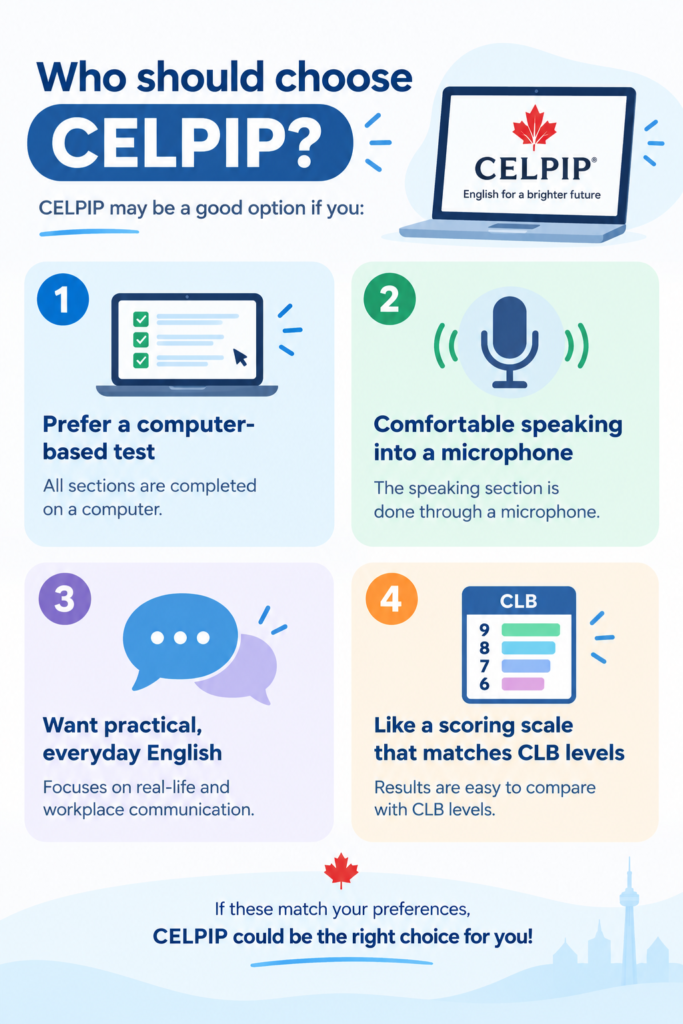
Who should choose CELPIP?
CELPIP may be a suitable option if you:
- Prefer completing all sections on a computer.
- Are comfortable speaking into a microphone.
- Want to practice practical, everyday English communication.
- Prefer a scoring scale that is straightforward to compare with CLB levels.
However, a computer-based format does not automatically make the test easier. You still need to demonstrate the required proficiency in every skill.
2. IELTS General Training: A Familiar Choice for Many Candidates
IELTS General Training is widely recognized internationally and is familiar to many applicants who have previously prepared for English language examinations.
It evaluates four skills: listening, reading, writing, and speaking.
What makes IELTS different?
IELTS General Training uses a band score system from 0 to 9. Your scores are converted to CLB levels separately for each ability.
The speaking section usually involves a conversation with a trained examiner. Some candidates prefer this format because they can interact with another person rather than speak to a computer.
The writing section includes a letter-writing task and an essay. Reading passages and listening exercises cover a range of everyday and general-interest situations.
Who should choose IELTS General Training?
IELTS may be a suitable choice if you:
- Feel comfortable communicating with a human examiner.
- Have already prepared for IELTS and understand its question patterns.
- Prefer its letter-writing and essay format.
- Have access to a convenient test center and suitable test dates.
One important consideration is that the overall IELTS band score is not enough to determine your CLB level. IRCC evaluates all four individual scores.
For example, the IELTS General Training scores required for CLB 9 are:
- Listening: 8.0
- Reading: 7.0
- Writing: 7.0
- Speaking: 7.0
A high overall band does not compensate for an individual skill that falls below your target CLB level.
3. PTE Core: An Alternative for Computer-Based English Testing
PTE Core is Pearson’s English language test accepted by IRCC for Canadian economic immigration applications, including Express Entry.
The test is computer-based and uses a range of integrated tasks to evaluate practical English proficiency. Some tasks assess more than one skill, such as speaking and listening or reading and writing.
What makes PTE Core different?
PTE Core reports scores on a scale from 10 to 90. You must use IRCC’s official conversion tables to determine your CLB level for each ability.
The exam includes computer-based speaking tasks, reading exercises, listening activities, and writing tasks. Candidates who are comfortable with structured computer exercises may find this format suitable.
PTE Core also has its own task patterns, so preparation should focus on the specific requirements of this exam rather than relying entirely on IELTS or CELPIP practice materials.
Who should choose PTE Core?
PTE Core may be worth considering if you:
- Prefer computer-based testing.
- Are comfortable responding to recorded prompts.
- Like practicing structured, timed tasks.
- Have performed well in official PTE Core practice materials.
- Want another approved option besides CELPIP and IELTS.
Do not confuse PTE Core with PTE Academic. For Express Entry, IRCC requires PTE Core.
CELPIP vs IELTS vs PTE Core: Which Is Easier?
There is no single test that is easiest for every candidate. Your results depend on your existing English skills, familiarity with the test format, preparation, and performance on the examination day.
Consider the following examples:
If you are comfortable speaking with people: IELTS General Training may suit you because its speaking section involves an examiner.
If you prefer computer-based speaking tasks, CELPIP-General or PTE Core may be worth exploring.
If you are familiar with IELTS question patterns: Continuing with IELTS may be more practical than starting preparation for a new examination.
If you prefer structured, integrated computer tasks, PTE Core could be a suitable option, provided its task format matches your strengths.
Before booking, complete an official practice test for the exams you are considering. Compare your performance across all four abilities instead of choosing a test solely because someone claims it is easier.
How Do These Tests Affect Your CRS Score?
Your English language test can have a significant impact on your Express Entry profile. However, your CRS score depends on several factors, including age, education, work experience, and other applicable criteria.
IRCC converts your results into CLB levels and awards points according to the applicable scoring rules.
For a useful comparison, consider the following IELTS General Training and CELPIP-General targets:
| CLB level | CELPIP-General | IELTS General Training |
| CLB 7 | 7 in each ability | 6.0 in each ability |
| CLB 8 | 8 in each ability | Listening 7.5; other abilities 6.5 |
| CLB 9 | 9 in each ability | Listening 8.0; other abilities 7.0 |
| CLB 10 | 10 or higher in each ability | Listening 8.5, reading 8.0, and writing and speaking 7.5 |
PTE Core has a different conversion scale. For example, the minimum PTE Core scores for CLB 9 are:
- Listening: 82
- Reading: 78
- Writing: 88
- Speaking: 84
Always verify the score requirements using the official IRCC table before submitting your profile.
Why is CLB 9 an important target?
CLB 9 can improve your language-related CRS points and may help you qualify for additional skill-transferability points when you meet the other applicable conditions.
For this reason, candidates should consider their target CLB level before deciding which test to take. The most useful exam is the one that gives you a realistic opportunity to achieve strong results in all four abilities.
Important Things to Check Before Booking Your Test
Before choosing CELPIP, IELTS, or PTE Core, review the following points.
1. Confirm your immigration program requirements.
Different Express Entry programs have different minimum language requirements. For example, the Federal Skilled Worker Program generally requires at least CLB 7 in all four abilities for the first official language, while the Canadian Experience Class requirements depend on the TEER category of your qualifying job.
2. Check your weakest ability.
Identify whether listening, reading, writing, or speaking needs the most improvement. Your lowest ability can affect your eligibility and overall points.
3. Compare official practice tests.
Practise using materials designed for each specific exam. Compare your scores and identify which format allows you to perform consistently.
4. Review test availability and fees.
Check the official test provider for available locations, booking dates, fees, rescheduling rules, and result timelines.
5. Check result validity.
IRCC requires your language test results to be less than two years old both when you complete your Express Entry profile and when you submit your permanent residence application.
Plan your test date carefully so your results remain valid throughout the process.
How Linguoprep Can Help You Prepare
Selecting the right English test is only the first step. A focused preparation plan can help you understand the question patterns, improve your weaker skills, and work towards your target CLB level.
At Linguoprep, candidates can explore language preparation options for IELTS, CELPIP, PTE Core, and French tests. Preparation should be tailored to your chosen examination, current proficiency, and target score.
Before beginning your preparation, consider taking a diagnostic assessment to identify your strengths and weaknesses. Regular practice, timed mock tests, and feedback on speaking and writing can help you prepare more effectively.
Visit Linguoprep to explore language test preparation options for your Canadian immigration goals.
Frequently Asked Questions
Q1. Is CELPIP, IELTS, or PTE Core better for Express Entry?
Ans. All three tests are accepted by IRCC for Express Entry when you take the correct version. The best choice depends on your test-taking preferences, current English skills, preparation, and ability to achieve your target CLB level.
Q2. Is IELTS Academic accepted for Express Entry?
Ans. No. IRCC requires IELTS General Training for Express Entry. IELTS Academic is not accepted as a substitute for this requirement.
Q3. Is PTE Core accepted for Canadian PR in 2026?
Ans. Yes. PTE Core is an approved English language test for Express Entry. Candidates must take PTE Core rather than PTE Academic and enter their individual scores correctly.
Q4. Can I combine scores from CELPIP, IELTS, and PTE Core?
Ans. No. You cannot combine individual abilities from different English tests to create one qualifying result. Use a complete result from an approved test and follow IRCC’s reporting requirements.
Q5. How long are English test results valid for Express Entry?
Ans. Language test results must be less than two years old when you complete your Express Entry profile and when you submit your permanent residence application.
Q6. Which CLB level should I target for Express Entry?
Ans. Your minimum requirement depends on your immigration program. CLB 9 is a useful target for many candidates because it can improve CRS language points and may help unlock skill-transferability points, depending on the rest of their profile.
Conclusion
Choosing between CELPIP, IELTS, and PTE Core requires more than comparing test fees or asking which examination is easiest. Each test has a different format, scoring system, and set of question types, but all three can meet IRCC’s English language testing requirement when the correct version is taken.
Start by checking your immigration program’s language requirements, identifying your weakest skill, and completing official practice tests. Then select the exam that best matches your strengths and preparation needs.
With a clear target and consistent practice, you can work towards the language scores needed for your Canadian permanent residence plans.
