
Many Punjabi and Gujarati-speaking students and professionals prepare for the CELPIP test to meet their Canadian immigration or permanent residence goals. While candidates may have strong English skills, they can still lose marks because of avoidable mistakes in speaking, writing, listening, and reading.
The common CELPIP mistakes Punjabi and Gujarati test-takers make are not the same for every individual. However, candidates who regularly use Punjabi, Gujarati, or another language alongside English may benefit from paying attention to grammar patterns, pronunciation, vocabulary, sentence structure, and test timing.
CELPIP is a computer-delivered English proficiency test that assesses listening, reading, writing, and speaking. The CELPIP-General test includes two writing tasks and eight speaking tasks, making familiarity with the test format an important part of preparation.
In this guide, we explain common preparation challenges, how to avoid them, and practical ways to improve your CELPIP performance.
1. Translating Punjabi or Gujarati Sentences Directly into English
One common language-learning challenge is translating sentences directly from a first language into English.
Punjabi and Gujarati have their own grammatical structures, expressions, and sentence patterns. When candidates translate word for word, their English sentences may sound unnatural or become grammatically incorrect.
For example:
- Incorrect: “I am having two brothers.”
- Better: “I have two brothers.”
Another example:
- Incorrect: “Discuss about the problem.”
- Better: “Discuss the problem.”
These examples are not mistakes made by every Punjabi or Gujarati speaker. They illustrate English grammar and usage issues that learners from different language backgrounds can encounter.
How to improve
- Practice thinking directly in English.
- Learn common English sentence patterns.
- Read English articles and short passages daily.
- Record yourself speaking and review your sentence structure.
- Practice rewriting translated sentences into natural English.
The goal is to communicate clearly rather than translate every thought word by word.
2. Using Memorized Answers in the CELPIP Speaking Test
Some candidates prepare speaking templates and memorize complete answers before the exam.
Templates can help organize ideas, but relying on memorized paragraphs may make answers sound repetitive or unrelated to the actual question.
CELPIP Speaking includes eight tasks, such as giving advice, describing a scene, comparing options, expressing opinions, and dealing with difficult situations. Each task requires a response suited to its specific instructions.
How to improve
Instead of memorizing complete answers, practice a flexible structure:
- Opening: Introduce your main idea.
- Explanation: Give relevant details.
- Example: Support your point with a realistic example.
- Conclusion: Finish naturally when appropriate.
For example, in a task asking you to give advice, explain your recommendation and why it could help.
Practice tip: Choose one random speaking topic daily and respond without reading a prepared script.
3. Speaking Too Fast or Too Slowly
Speaking quickly does not automatically demonstrate strong English proficiency. Some candidates speak too fast because they are nervous, while others pause frequently because they are searching for vocabulary.
Both patterns can affect clarity and the flow of an answer.
CELPIP speaking responses are assessed using criteria that include content and coherence, vocabulary, listenability, and task fulfillment.
How to improve
- Speak at a comfortable, steady pace.
- Use short pauses between ideas.
- Practice speaking for the time allowed in each task.
- Avoid unnecessary fillers such as “umm,” “actually,” and “you know.”
- Record your answers and listen for unclear words or rushed sentences.
You do not need to imitate a Canadian accent. Focus on understandable pronunciation, appropriate pacing, and clear communication.
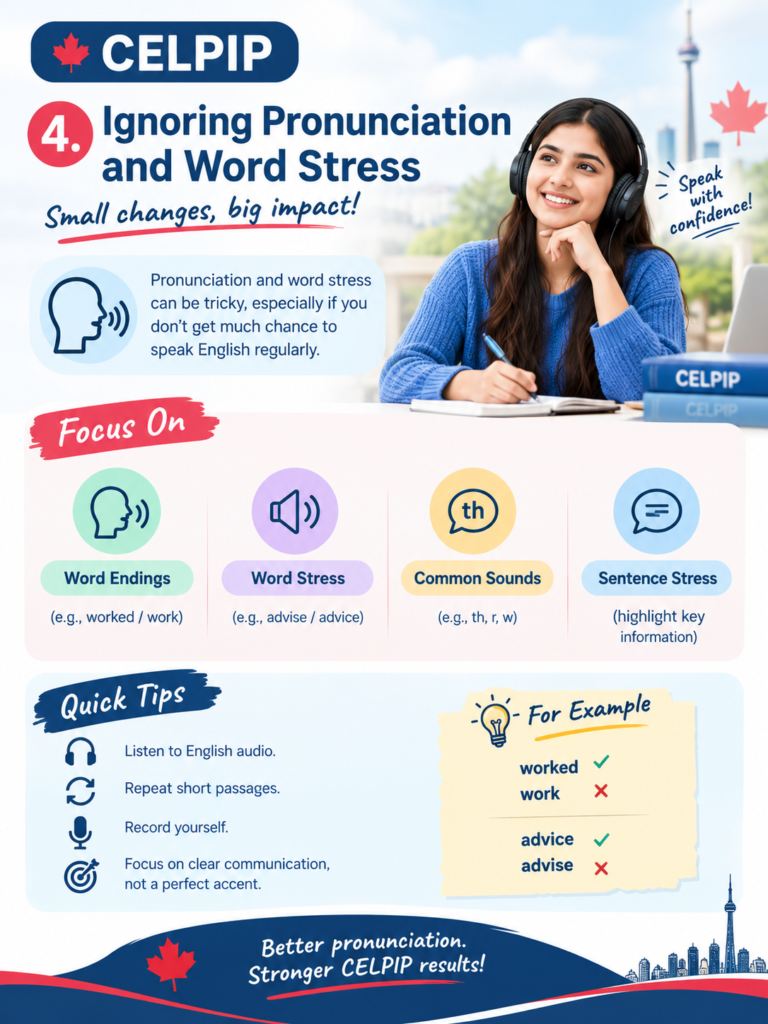
4. Ignoring Pronunciation and Word Stress
Pronunciation is another area that learners may want to practice, particularly if they have limited opportunities to speak English regularly.
Certain English sounds, word endings, or stress patterns may require additional practice. However, pronunciation challenges vary between individuals and cannot be predicted simply from whether someone speaks Punjabi or Gujarati.
How to improve
Practice:
- Word endings, especially plural and past-tense sounds.
- Stress in longer words.
- Clear pronunciation of commonly confused sounds.
- Sentence stress to highlight important information.
For example, practice distinguishing “worked” from “work” and “advice” from “advise.”
Listen to English audio, repeat short passages, and record yourself. The objective is clear communication, not eliminating your natural accent.
5. Writing Long Sentences with Grammar Mistakes
In the CELPIP Writing section, candidates complete an email and respond to survey questions.
Some candidates try to use complicated vocabulary and lengthy sentences to demonstrate advanced English. However, longer sentences can become difficult to follow when punctuation, grammar, or sentence structure is weak.
Common writing mistakes
- Incorrect subject-verb agreement.
- Missing articles such as “a,” “an,” and “the.”
- Incorrect prepositions.
- Repeating the same vocabulary.
- Writing sentences that are too long.
- Missing important parts of the task.
How to improve
Write clear sentences with one main idea at a time.
For an email, organize your response into:
- A suitable greeting and purpose.
- Relevant details and explanations.
- A clear closing.
For a survey response, state your choice, explain your reasons, and provide supporting examples.
Practise checking grammar, punctuation, and whether you have answered every part of the question.
6. Misunderstanding the Listening Section
The CELPIP Listening section includes different types of conversations, information, news items, discussions, and viewpoints.
Candidates may understand individual words but miss the overall meaning, the speaker’s intention, or a change in viewpoint.
This can happen when they focus on translating every sentence instead of following the conversation.
How to improve
- Listen to English conversations and news regularly.
- Practice identifying the main idea and supporting details.
- Pay attention to tone, opinions, and changes in the conversation.
- Take brief notes when useful.
- Practice with timed listening exercises.
Important: CELPIP Listening audio is not something you should expect to replay freely during the test. Practise listening carefully the first time and answering based on the information provided.
7. Reading Too Slowly and Spending Too Much Time on One Question
Reading passages can include correspondence, diagrams, information, and different viewpoints.
A common preparation problem is reading every sentence repeatedly or spending too long on one difficult question.
This can leave insufficient time for the remaining questions.
How to improve
- Read the question carefully before searching for details.
- Identify keywords and relevant information.
- Practice understanding the main idea of each paragraph.
- Use timed practice tests.
- If a question is difficult, avoid getting stuck on it.
Build your reading speed gradually while maintaining comprehension. Reading faster is useful only when you still understand the passage.
8. Not Managing Time in Writing and Speaking
CELPIP is a timed test. Candidates need to organize their thoughts and complete tasks within the available time.
The Writing section has two tasks, while Speaking includes eight recorded responses.
Some candidates spend too much time planning, while others begin speaking or writing immediately without organizing their ideas.
How to improve
For writing:
- Divide your practice time between planning, writing, and reviewing.
- Use a clear structure.
- Leave time to check grammar and missing details.
For speaking:
- Practice with a timer.
- Use preparation time to identify two or three key points.
- Avoid spending too long on introductions.
- Complete the task rather than stopping after one sentence.
Practicing under realistic test conditions can help you become more comfortable with the format.
9. Using Advanced Vocabulary Incorrectly
A larger vocabulary can help you express ideas precisely. However, using unfamiliar words incorrectly may make your response confusing.
Some candidates memorize lists of advanced words and try to include them in every answer.
How to improve
Learn vocabulary through context rather than memorizing isolated words.
For example:
- Practice synonyms and understand when each is appropriate.
- Learn common collocations such as “make a decision” and “take responsibility.”
- Use vocabulary that matches the situation.
- Prioritize accuracy and clarity over unnecessarily complicated words.
A clear, natural answer is more useful than a complicated answer that does not communicate the intended meaning.
10. Practicing Without Reviewing Mistakes
Completing many mock tests does not automatically guarantee improvement.
Candidates may repeat the same grammar, vocabulary, timing, or comprehension mistakes if they do not review their performance.
How to improve
After each practice test:
- Identify the questions or tasks where you struggled.
- Note recurring grammar and vocabulary errors.
- Review incorrect listening and reading answers.
- Listen to your speaking recordings.
- Rewrite weak responses and practice them again.
Keep a simple mistake tracker with the following columns:
| Skill | Mistake | Improvement plan |
| Speaking | Too many pauses | Timed speaking practice |
| Writing | Grammar errors | Sentence correction |
| Listening | Missing key details | Active listening |
| Reading | Slow question completion | Timed reading exercises |
Review your progress regularly and adjust your preparation based on your actual performance.
How Punjabi and Gujarati Test-Takers Can Prepare for CELPIP
There is no single preparation method that works for every candidate. Your study plan should depend on your current English level, target CELPIP scores, and the areas where you need improvement.
A practical routine may include:
- Daily English listening practice.
- Speaking practice using different CELPIP task types.
- Writing emails and survey responses under timed conditions.
- Reading English passages and answering comprehension questions.
- Reviewing grammar and vocabulary mistakes.
- Completing full-length practice tests to become familiar with the format.
Candidates preparing for Canadian permanent residence should also confirm the language-test requirements and minimum scores applicable to their immigration program.
Get CELPIP Preparation Support with Linguoprep
Preparing for CELPIP requires more than learning vocabulary or memorizing speaking templates. Understanding the test format, practicing all four language skills, and identifying your individual weaknesses can help you build a structured preparation routine.
At Linguoprep, candidates can explore English language preparation support and work on improving their CELPIP skills for their Canadian immigration goals.
Whether you need help with speaking fluency, writing structure, listening comprehension, or reading practice, focus on building the skills that need the most attention.
Visit Linguoprep to explore preparation resources and take the next step in your CELPIP journey.
Frequently Asked Questions (FAQs)
Q1. What are common CELPIP mistakes? Punjabi and Gujarati speakers should watch for?
Potential challenges include direct translation, grammar errors, unclear pronunciation, overusing memorized answers, and poor time management. These issues vary by individual and are not specific to every Punjabi or Gujarati speaker.
Q2. Is a Punjabi or Gujarati accent a problem in CELPIP?
No. You do not need to eliminate your natural accent. Focus on clear pronunciation, understandable speech, appropriate pacing, and completing the speaking task effectively.
Q3. How can I improve my CELPIP Speaking score?
Practise all eight speaking task types, organise your answers clearly, use relevant examples, and record yourself to identify areas for improvement. Review your responses against the official speaking criteria.
Q4. Should I memorize CELPIP Speaking answers?
It is better to learn flexible structures rather than memorize complete answers. Templates can help organize your response, but your answer should directly address the specific question.
Q5. How can I improve CELPIP writing?
Practise email writing and survey responses under timed conditions. Focus on grammar, clear organization, relevant details, vocabulary, and answering all parts of the task.
Q6. How can Linguoprep help with CELPIP preparation?
Linguoprep provides language-preparation support for candidates who want to develop their English skills. Visit its website to explore available resources and preparation options
