
Preparing for the CELPIP exam requires more than practicing English. Candidates also need to understand the test format, manage their time, and perform consistently under exam conditions.
Free CELPIP mock tests help candidates practice different question types without spending money on every preparation resource. However, many students wonder whether these tests accurately reflect the real exam.
The answer depends on the quality of the practice material, its scoring method, and how closely it follows the official test format. Mock tests can help you understand your preparation level, but they cannot guarantee your actual CELPIP score.
How Accurate Are CELPIP Free Mock Tests?
Free CELPIP mock tests can be useful for practicing question formats, improving time management, and identifying weak areas. However, their accuracy varies between platforms.
Some practice tests closely follow the official format, while others may use easier questions, shorter passages, or different scoring systems.
A useful mock test should include:
- Question types similar to the official exam.
- Appropriate time limits.
- Listening and reading exercises.
- Complete speaking and writing tasks.
- Feedback that helps you understand your mistakes.
Use mock-test scores as a general indication of your preparation, not as a guaranteed prediction of your official result.
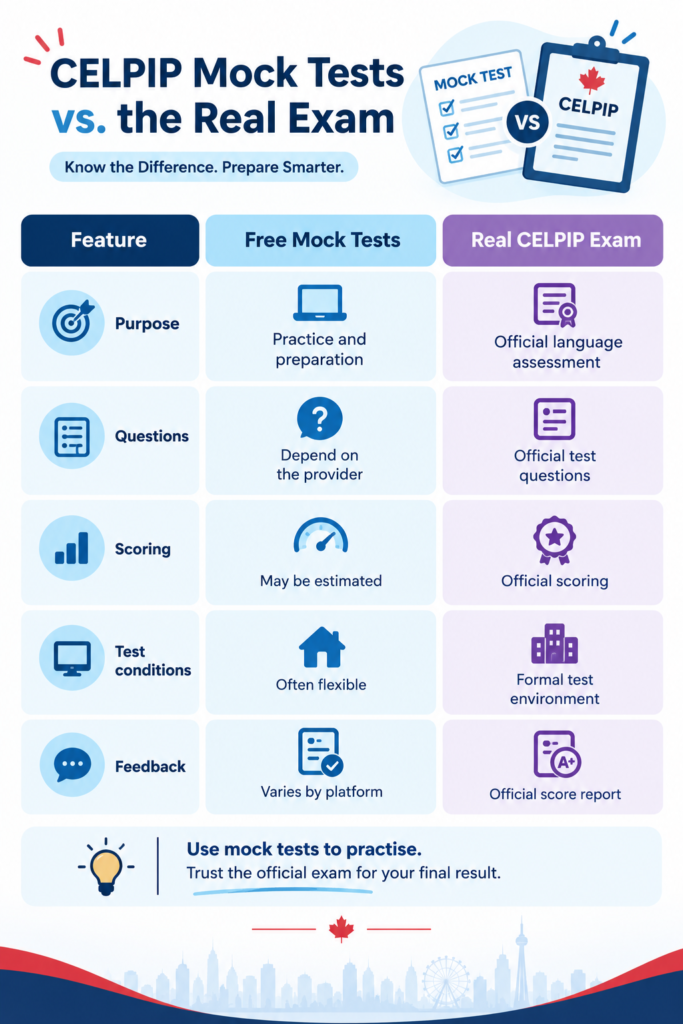
CELPIP Mock Tests vs. the Real Exam
| Feature | Free mock tests | Real CELPIP exam |
| Purpose | Practice and preparation | Official language assessment |
| Questions | Depend on the provider. | Official test questions |
| Scoring | May be estimated | Official scoring |
| Test conditions | Often flexible | Formal test environment |
| Feedback | Varies by platform | Official score report |
The main difference is that mock tests are preparation tools, while the real exam provides an official assessment.
1. Question Format and Difficulty
Mock tests introduce candidates to common question formats and help them understand what each task requires.
However, not every free practice test matches the difficulty of the official exam. Some may contain simpler vocabulary, shorter passages, or less challenging listening exercises.
Relying on only one easy practice test may give you an unrealistic idea of your preparation level.
To improve, practice with different question sets and focus on understanding the instructions. Avoid memorizing answers because the actual questions may be different.
2. Listening: How Closely Do Practice Tests Match?
Listening mock tests help candidates practise understanding conversations, identifying important details, and recognising the main idea.
However, audio quality, speaking speed, and difficulty can vary across unofficial resources. Some recordings may be easier to understand than the material you find challenging during the real exam.
How to improve listening
- Practice without pausing the recording.
- Focus on the main idea and important details.
- Pay attention to names, numbers, and reasons.
- Review incorrect answers carefully.
- Practice with different English speakers.
Try new listening exercises instead of repeatedly completing the same test. This helps you check whether your listening skills are actually improving.
3. Reading: Are Free Practice Questions Reliable?
Reading mock tests helps candidates practise locating information, understanding passages, and managing their time.
However, unofficial reading materials may not always match the length, vocabulary, or complexity of the official exam.
To improve your reading performance, carefully read each question and look for supporting information in the passage. Avoid choosing answers based only on general knowledge.
Practise completing exercises within a set time. Spending too long on one difficult question can affect your ability to complete the remaining tasks.
4. Writing: Why Mock-Test Scores Can Be Misleading
Writing is an area where candidates should be careful when interpreting free mock-test scores.
Some platforms use automated scoring systems. These may provide useful feedback, but their scores are not necessarily the same as official CELPIP results.
Focus on the quality of your response, including:
- Answering the task completely.
- Organizing ideas logically.
- Using suitable vocabulary.
- Writing clear sentences.
- Checking grammar and spelling.
- Following the instructions and word requirements.
Practise writing complete responses and review them afterward. If possible, seek feedback from a qualified CELPIP preparation instructor who can explain your mistakes.
5. Speaking: Can Mock Tests Predict Your Score?
Speaking mock tests help candidates practise responding to prompts within a time limit. They can also make you more comfortable speaking into a microphone.
However, automated speaking scores from unofficial platforms should not be treated as official predictions.
A good speaking response should be relevant, clear, and organized. Speaking quickly or using advanced vocabulary does not automatically mean your answer is effective.
Speaking practice tips
- Read the instructions carefully.
- Organize your main ideas before speaking.
- Use examples to explain your points.
- Speak clearly at a natural pace.
- Avoid long pauses and unnecessary repetition.
- Record your responses and review them.
Practise different speaking tasks instead of memorising one answer for every situation.
6. Why Your Mock-Test Score May Differ From Your Real Score
Your mock-test score may differ from your official result for several reasons.
Different question difficulty: One practice test may be easier than another, making the scores difficult to compare.
Different scoring methods: Unofficial platforms may use their own scoring systems, which may not match official assessment.
Test-day conditions: Concentration, time management, and unfamiliarity with the test environment can affect performance.
Repeated practice: Repeating the same questions may improve your score because you remember the answers, not necessarily because your English has improved.
For a clearer picture of your preparation, complete new practice tests under timed conditions and track your performance over time.
7. How to Use Free CELPIP Mock Tests Properly
Mock tests are most useful when combined with a structured preparation routine.
- Take a diagnostic test: Complete a practice test to identify your strengths and weaknesses.
- Review mistakes: Understand why your answers were incorrect instead of focusing only on your score.
- Practice weak areas: Spend additional time on the sections and question types you find difficult.
- Use time limits: Practice under timed conditions to improve your pacing.
- Try new questions: Avoid relying on repeated tests or memorized answers.
- Track progress: Record your practice results and note which skills are improving.
A balanced routine should include practice, review, and focused skill development.
8. Common Mistakes to Avoid
Candidates sometimes complete many mock tests without making meaningful progress.
Avoid these common mistakes:
- Trusting every unofficial score.
- Repeating the same test too often.
- Ignoring task instructions.
- Practicing without time limits.
- Focusing only on strong sections.
- Memorizing speaking and writing answers.
- Skipping the review of incorrect responses.
Remember that taking more tests does not automatically mean better preparation. Understanding and correcting mistakes is equally important.
9. Choosing Reliable CELPIP Preparation Materials
When choosing practice materials, check whether the provider explains its test format, scoring approach, and limitations.
Official CELPIP preparation resources are a useful starting point. Additional mock tests can provide more opportunities to practice, but avoid relying on websites that promise exact score predictions or guaranteed results.
For speaking and writing, feedback can be especially helpful because candidates may not recognize their own mistakes. Choose resources that explain how to improve rather than simply displaying a score.
10. How Linguoprep Can Help With CELPIP Preparation
Preparing for CELPIP involves more than completing free mock tests. Candidates also need regular practice, feedback, and strategies for different question types.
Linguoprep offers language-test preparation support for candidates who want to improve their English skills and prepare for exam tasks.
With structured practice, candidates can work on speaking responses, writing organization, listening comprehension, and reading strategies.
Explore preparation support at Linguoprep.
Preparation support cannot guarantee a particular CELPIP score. Your official result depends on your performance in the exam.
Frequently Asked Questions
1. Are free CELPIP mock tests accurate?
They can help you practice question formats and assess your preparation, but accuracy varies by provider. Their scores are not guaranteed predictions of your official result.
2. Can I get the same score in the real CELPIP exam?
It is possible, but not guaranteed. Your actual result may differ because of question difficulty, scoring methods, and test-day performance.
3. Are free CELPIP speaking mock tests reliable?
They are useful for practicing timing and organizing responses. However, automated scores from unofficial platforms may not match official scoring.
4. How many mock tests should I complete?
There is no fixed number for everyone. Focus on reviewing mistakes and improving weak areas rather than completing many tests without learning from them.
5. Should I use only free CELPIP mock tests?
Free tests can support your preparation, but it is helpful to use official preparation resources and other suitable materials as well.
Conclusion
Free CELPIP mock tests can help you become familiar with question formats, practice time management, and identify areas that need improvement.
However, a practice score is not an official result and cannot guarantee your performance on exam day. Differences in difficulty, scoring methods, and testing conditions can affect your results.
Use mock tests alongside focused practice, careful review, and reliable preparation materials. By understanding your mistakes and consistently improving weaker skills, you can prepare with a clearer understanding of your progress.
For additional language test preparation support, visit Linguoprep.
