
Achieving IELTS Band 9 is one of the biggest goals for students and professionals who need a high level of English for studying, working, or moving abroad. But with IELTS information changing over time, many candidates are asking an important question: What has changed in IELTS scoring in 2026?
If you are preparing for IELTS this year, there is an important distinction to understand. The core IELTS 9-band scoring system is still in place. Candidates continue to receive individual band scores for Listening, Reading, Writing and Speaking, along with an overall band score. The overall result is calculated using the scores from all four sections.
What has changed or been updated around IELTS includes areas such as test delivery, result documentation and the availability of options such as One Skill Retake. These developments should not be confused with a complete replacement of the IELTS scoring system.
For anyone following an IELTS Band 9 Roadmap 2026, the best approach is therefore to understand the current scoring system, know exactly what examiners assess, and prepare strategically for each section.
What Is IELTS Band 9?
IELTS uses a 9-band scale to measure English language proficiency. The highest possible score is Band 9, which IELTS describes as the Expert level.
A Band 9 candidate demonstrates complete or near-complete command of English and can communicate accurately, fluently and appropriately in different situations.
The IELTS bands are generally described as:
- Band 9 – Expert
- Band 8 – Very Good
- Band 7 – Good
- Band 6 – Competent
- Band 5 – Modest
- Band 4 – Limited
- Band 3 – Extremely Limited
- Band 2 – Intermittent
- Band 1 – Non-user
- Band 0 – Did not attempt the test
IELTS does not have a traditional pass or fail score. Instead, your result shows how well you performed in each language skill.
This is important because a candidate may have a high overall score but a lower score in one particular section.
Has IELTS Scoring Changed in 2026?
One of the biggest misconceptions surrounding IELTS preparation in 2026 is that the entire scoring system has been replaced.
It has not.
The IELTS 9-band scale remains the foundation of the test. Your performance is still reported separately for:
- Listening
- Reading
- Writing
- Speaking
These four scores are then used to calculate your overall IELTS band score.
However, IELTS continues to make updates to its testing and result systems. Candidates may also notice changes to documentation and Test Report Forms. These administrative or result-related updates should not be interpreted as a completely new scoring formula.
Therefore, if you are preparing for IELTS in 2026, you do not need to throw away everything you learned from previous IELTS preparation. Instead, make sure your preparation materials and practice tests reflect the current official IELTS format and assessment criteria.
How Is the IELTS Overall Band Score Calculated?
Your overall IELTS band score is calculated from your four individual section scores.
The basic calculation is:
Listening + Reading + Writing + Speaking ÷ 4
The resulting average is then rounded according to IELTS scoring rules.
For example, imagine a candidate receives:
- Listening: 8.5
- Reading: 8.0
- Writing: 7.5
- Speaking: 8.0
The average is
(8.5 + 8.0 + 7.5 + 8.0) ÷ 4 = 8.0
Therefore, the overall IELTS score would be Band 8.0.
Understanding this calculation is especially important for candidates who are targeting Band 8 or Band 9 because a small difference in one section can affect the final overall result.
A candidate should also remember that universities, employers and immigration programs may have their own minimum requirements for individual sections. Therefore, achieving the required overall score does not always mean that every application requirement has been met.
IELTS Listening Scoring in 2026
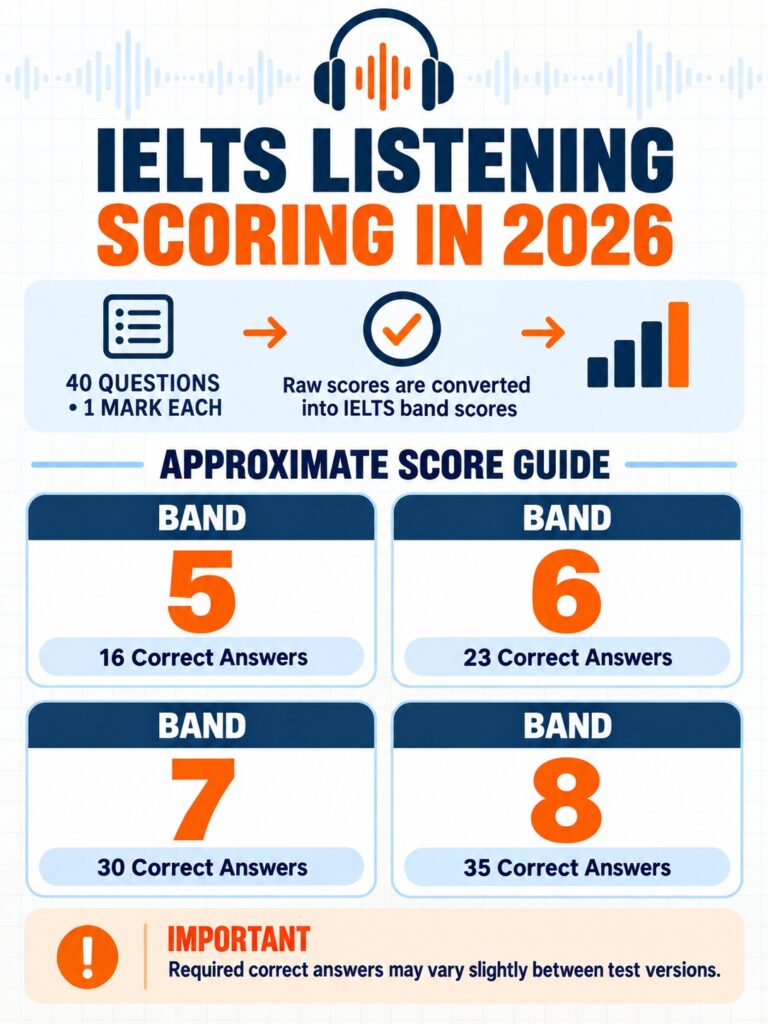
The IELTS Listening test contains 40 questions. Candidates receive one mark for each correct answer, and the raw score is converted into an IELTS band score.
IELTS provides approximate conversion guidance. The exact number of correct answers needed for a particular band can vary slightly between test versions.
For example, approximately:
- Band 5 – 16 correct answers
- Band 6 – 23 correct answers
- Band 7 – 30 correct answers
- Band 8 – 35 correct answers
If your goal is Band 9, you need to perform at an exceptionally high level.
How to Improve Your Listening Score
Simply listening to English casually is not enough if you want a very high IELTS score.
Your preparation should include:
- Practicing different English accents
- Understanding paraphrased information
- Predicting possible answers
- Identifying distractors
- Improving spelling
- Listening for numbers, names and dates
- Practising multiple-choice questions
- Reviewing every incorrect answer
One of the most effective habits is to analyse your mistakes after every practice test.
If you repeatedly lose marks because you miss changes in information or fall for distractors, simply taking another test will not solve the problem. You need to understand the reason behind the mistake.
IELTS Reading Scoring in 2026
IELTS Reading also contains 40 questions, with one mark awarded for each correct answer.
The raw score is converted to the IELTS 9-band scale. The conversion requirements differ between Academic Reading and General Training Reading, so candidates should practise using the version that matches their test.
For Academic Reading, IELTS currently gives approximate examples such as:
- Band 5 – around 15 correct answers
- Band 6 – around 23
- Band 7 – around 30
- Band 8 – around 35
These figures are approximate because score conversion can vary between test versions.
How to Prepare for Band 9 Reading
Band 9 Reading requires more than knowing thousands of English words.
You need to become comfortable with:
- Skimming
- Scanning
- Identifying keywords
- Recognising paraphrases
- Understanding the writer’s opinion
- Finding specific information
- Matching headings
- True/False/Not Given questions
- Managing your time
A common mistake is trying to understand every sentence perfectly before answering questions.
IELTS Reading is a timed test. You need to develop the ability to locate relevant information quickly while still understanding the meaning of the text.
IELTS Writing Scoring: What Examiners Look For
Writing is one of the sections where preparation needs to be particularly structured.
IELTS Writing is assessed using four main criteria:
1. Task Achievement or Task Response
Your answer must address the task appropriately and develop the required ideas.
For Task 1, this involves accurately fulfilling the requirements of the question. For Task 2, you need to respond directly to the essay question and develop your position and ideas clearly.
2. Coherence and Cohesion
Your writing should be logically organised.
The examiner should be able to follow your ideas without difficulty. Paragraphing, progression and the appropriate use of cohesive devices all contribute to this criterion.
3. Lexical Resource
This refers to your vocabulary.
A Band 9 candidate does not simply use complicated words. The vocabulary should be wide, precise and appropriate to the context.
Using an advanced word incorrectly can be worse than using a simpler word correctly.
4. Grammatical Range and Accuracy
High-level candidates demonstrate a range of grammatical structures while maintaining a high level of accuracy.
This does not mean filling every sentence with complicated grammar. Clear, accurate and naturally varied sentence structures are more important.
Is Band 9 Writing About Using Difficult English?
No.
This is one of the biggest mistakes candidates make when preparing for IELTS.
Some students believe that using extremely complicated vocabulary automatically produces a Band 8 or Band 9 answer.
That is not how IELTS assessment works.
Instead of memorising unusual words, focus on:
- Clear ideas
- Accurate vocabulary
- Appropriate examples
- Logical paragraph structure
- Strong grammar
- Relevant explanations
- Good sentence variety
- Accurate spelling and punctuation
Your writing should sound natural and controlled rather than artificially complicated.
IELTS Speaking Scoring in 2026
IELTS Speaking is assessed using four criteria:
- Fluency and coherence
- Lexical resource
- Grammatical range and accuracy
- Pronunciation
Each criterion contributes to your Speaking score.
For a high score, candidates need to demonstrate the ability to communicate naturally and effectively.
How to Prepare for Band 9 Speaking
Do not rely on memorised answers.
Instead, practise speaking about different topics and developing your ideas naturally.
For example, if you are asked about your favourite place, do not simply say:
“I like this place because it is beautiful.”
Develop the response by explaining:
- Where the place is
- When you visited it
- What you liked about it
- Why it was memorable
- Whether you would recommend it
This allows you to demonstrate vocabulary, grammar, fluency and coherence.
Also practise speaking without excessive hesitation. Occasional pauses are normal, but frequent stopping because you are searching for memorised sentences can affect the naturalness of your response.
IELTS Band 9 Roadmap 2026: Step-by-Step Preparation Plan
If Band 9 is your target, preparation should follow a clear process.
Step 1: Take a Diagnostic Test
Before starting intensive preparation, complete a realistic IELTS practice test.
This gives you a starting point.
For example, if your current results are:
- Listening – 8.0
- Reading – 8.0
- Writing – 6.5
- Speaking – 7.0
Your strategy should focus more heavily on Writing and Speaking.
Step 2: Identify Your Weak Areas
Do not simply ask, “What is my IELTS score?”
Ask:
Why am I losing marks?
Maybe you understand the Reading passage but struggle with Matching Headings.
Maybe you have good ideas in Writing but make grammatical errors.
Maybe you speak confidently but repeat the same vocabulary.
Identifying these patterns makes preparation more efficient.
Step 3: Create a Weekly Study Plan
A balanced weekly plan could look like:
Monday: Reading practice
Tuesday: Writing Task 2
Wednesday: Listening practice
Thursday: Speaking practice
Friday: Writing Task 1 + vocabulary
Saturday: Full mock test
Sunday: Mistake analysis and revision
Your schedule can be changed according to your current level and exam date.
Step 4: Maintain an Error Log
Write down your repeated mistakes.
For example:
Reading: I confuse False and Not Given.
Listening: I lose marks because of spelling.
Writing: I use repetitive vocabulary.
Speaking: I pause too often while searching for words.
Reviewing these patterns every week can help you focus on the areas that actually need improvement.
Step 5: Practise With Time Limits
IELTS is not only a test of English ability. It is also a test of how effectively you can use your English within the available time.
Practise under realistic time conditions as your exam approaches.
Step 6: Use Reliable Preparation Material
Be careful with websites and social media posts claiming that IELTS has introduced a completely new scoring system in 2026.
Always compare such claims with information from official IELTS sources.
This is particularly important when you are preparing for a high-stakes application.
IELTS One Skill Retake in 2026
Another useful option available to eligible IELTS candidates is One Skill Retake.
It allows eligible test takers to retake one of the four IELTS skills rather than taking the complete test again.
For example, if your original result is:
- Listening – 8.0
- Reading – 8.5
- Writing – 6.5
- Speaking – 8.0
and you need to improve Writing, One Skill Retake may allow you to retake that skill instead of repeating all four sections.
However, acceptance of a one-skill retake can depend on the organization or immigration program you are applying to.
Before relying on it, check whether the university, employer, or relevant immigration authority accepts the result for your specific purpose.
Common Mistakes IELTS Candidates Should Avoid
Following IELTS Scoring Rumors
Do not change your preparation strategy simply because you saw a social media post claiming that IELTS scoring has completely changed.
Check official IELTS information first.
Memorising Essays
A memorized essay may not properly answer the actual question and can make your writing appear unnatural.
Learn structures and strategies instead of memorising complete answers.
Using Unfamiliar Vocabulary
Never use a word simply because it sounds advanced.
Accuracy and appropriateness matter.
Ignoring Your Weakest Skill
If three sections are strong but one is consistently weak, that section deserves targeted practice.
Taking Too Many Mock Tests
Mock tests are useful, but only when you analyze them.
A test without review gives you a score. Analysis gives you an opportunity to improve.
IELTS Band 9 Roadmap 2026: What Should You Focus On?
The most important lesson for IELTS preparation in 2026 is that you should focus on performance rather than rumors about scoring changes.
The core IELTS system continues to use the 0–9 scale, with individual results for Listening, Reading, Writing and Speaking.
If Band 9 is your goal, focus on:
- Understanding the official assessment criteria
- Building strong English fundamentals
- Improving accuracy
- Expanding vocabulary naturally
- Developing fluency
- Practicing under time limits
- Analyzing mistakes
- Using reliable preparation resources
- Checking the latest requirements of your university or immigration program
Final Thoughts
The IELTS Band 9 Roadmap 2026 is not about learning an entirely new scoring system. It is about understanding the current IELTS assessment process and preparing intelligently for each skill.
The 9-band scale remains central to IELTS scoring. Listening and Reading use raw scores that are converted into bands, while Writing and Speaking are assessed against specific criteria.
If you want Band 9, do not depend on shortcuts or memorised answers. Start by finding your current level, identify your weaknesses and build a preparation plan around them.
Most importantly, use current and reliable IELTS information when preparing for your test. Requirements can differ depending on whether you need IELTS for university admission, professional purposes, employment or immigration.
A strong IELTS result is possible with consistent preparation, but the best strategy is to focus on accuracy, fluency, time management and understanding how the test is actually assessed.
Frequently Asked Questions
Q1. Is IELTS scoring changing in 2026?
The core IELTS 9-band scoring system remains in use. Candidates continue to receive individual scores for Listening, Reading, Writing and Speaking, as well as an overall band score.
Q2. Is Band 9 the highest IELTS score?
Yes. Band 9 is the highest score on the IELTS 9-band scale and represents an Expert level of English proficiency.
Q3. How is the IELTS overall band calculated?
The overall score is calculated by averaging the four individual skill scores and applying IELTS rounding rules.
Q4. Can I get Band 9 overall without scoring Band 9 in every section?
Yes. Your overall score is based on the average of your four section scores, so you do not necessarily need Band 9 in every individual skill to achieve a particular overall score.
Q5. Is IELTS Writing scored based only on grammar?
No. IELTS Writing is assessed using four criteria: Task Achievement/Task Response, Coherence and Cohesion, Lexical Resource, and Grammatical Range and Accuracy.
Q6. Can I retake only one IELTS section?
Eligible candidates may be able to use IELTS One Skill Retake to retake one skill. However, you should check whether the organisation or immigration authority you are applying to accepts One Skill Retake.
Q7. What is the best way to prepare for IELTS Band 9?
Start with a diagnostic test, identify your weakest areas, practise each skill separately, complete timed mock tests and analyse your mistakes. Consistent targeted practice is more useful than simply completing large numbers of tests.
