If you are planning to immigrate to Canada, apply through Express Entry, obtain permanent residency, or apply for Canadian citizenship, understanding how CELPIP Scores Convert to CLB Levels is essential.
Your Canadian Language Benchmark level directly impacts your eligibility for immigration programs and can significantly affect your Comprehensive Ranking System score.
Many test takers search for a CELPIP to CLB conversion chart because they want to know whether their language scores meet Canadian immigration requirements.
The good news is that CELPIP is one of the simplest English language tests when it comes to CLB equivalency.
This guide by LinguoPrep explains everything you need to know about how CELPIP scores convert to CLB levels, including score charts, immigration requirements, CRS implications, and practical tips to improve your results.
Key Insight: CELPIP uses a direct score-to-CLB relationship. A CELPIP score of 9 equals CLB 9, making immigration score interpretation easier for applicants.
Quick Answer: How Do CELPIP Scores Convert to CLB Levels?
CELPIP scores convert directly to Canadian Language Benchmark levels on a simple 1:1 scale.
For example:
| CELPIP Score | CLB Level | Description or Proficiency Level |
|---|---|---|
| 12 | CLB 12 | Advanced proficiency in workplace and community contexts |
| 11 | CLB 11 | Advanced proficiency in workplace and community contexts |
| 10 | CLB 10 | Highly effective proficiency in workplace and community contexts |
| 9 | CLB 9 | Effective proficiency in workplace and community contexts |
| 8 | CLB 8 | Fluent intermediate proficiency in workplace and community contexts |
| 7 | CLB 7 | Adequate intermediate proficiency in workplace and community contexts |
| 6 | CLB 6 | Developing intermediate proficiency in workplace and community contexts |
| 5 | CLB 5 | Initial intermediate proficiency in workplace and community contexts |
| 4 | CLB 4 | Fluent basic proficiency in workplace and community contexts |
Unlike IELTS, which requires a separate score conversion chart, CELPIP scores correspond directly with CLB levels.
ALSO READ:CELPIP to CLB Conversion Explained for Express Entry
What Is the Canadian Language Benchmark?
The Canadian Language Benchmark is Canada’s official system for measuring English language proficiency.
Immigration, Refugees and Citizenship Canada uses CLB levels to assess whether applicants possess sufficient English language ability for different immigration and citizenship programs.
The CLB scale is generally divided into three proficiency ranges:
- CLB 1–4: Basic proficiency
- CLB 5–8: Intermediate proficiency
- CLB 9–12: Advanced proficiency
Your language ability is evaluated separately in:
- Listening
- Reading
- Writing
- Speaking
A higher CLB level generally means a stronger immigration profile and the possibility of receiving more CRS points.
Official CELPIP Score Chart
The following CELPIP score chart shows the direct relationship between CELPIP scores and CLB levels.
| CELPIP Score | CLB Level | Proficiency Description |
|---|---|---|
| 12 | CLB 12 | Expert Proficiency |
| 11 | CLB 11 | Advanced Proficiency |
| 10 | CLB 10 | Highly Effective Proficiency |
| 9 | CLB 9 | Effective Proficiency |
| 8 | CLB 8 | Good Proficiency |
| 7 | CLB 7 | Adequate Proficiency |
| 6 | CLB 6 | Developing Proficiency |
| 5 | CLB 5 | Acquiring Proficiency |
| 4 | CLB 4 | Daily Communication Ability |
CELPIP score reports display the result for each language ability, making it easier for candidates to understand their CELPIP CLB equivalency.
Why Understanding CELPIP CLB Equivalency Matters
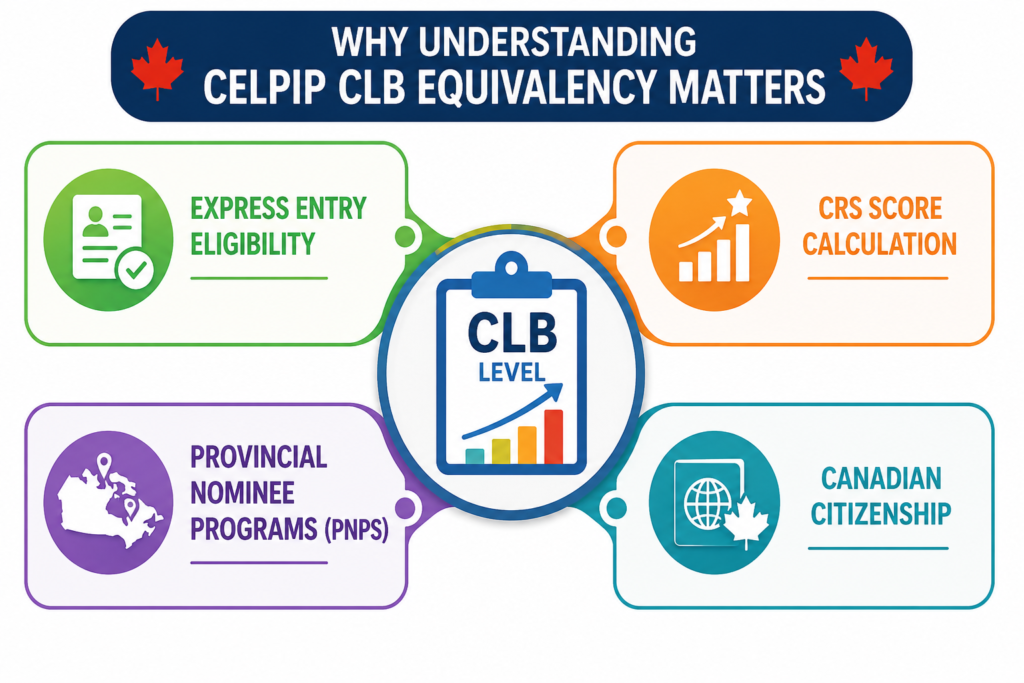
Many applicants underestimate the importance of understanding CELPIP and CLB score equivalency for immigration.
Your CLB level can affect:
Express Entry Eligibility
Different Express Entry programs establish minimum language requirements based on individual CLB scores.
The Federal Skilled Worker Program generally requires candidates to achieve at least CLB 7 in all four language abilities.
CRS Score Calculation
Language scores can contribute a substantial number of Comprehensive Ranking System points.
Even a one-level increase in Listening, Reading, Writing, or Speaking may improve your Express Entry ranking.
Provincial Nominee Programs
Many Provincial Nominee Programs establish language requirements based on CLB levels Canada standards.
Higher CLB scores can also improve eligibility for certain provincial immigration streams.
Canadian Citizenship
Eligible citizenship applicants may need to demonstrate the required language ability in Listening and Speaking, subject to current citizenship rules.
Immigration Insight: IRCC evaluates each language skill separately. A lower score in one ability may affect eligibility even when your other three scores are high.
What CELPIP Score Is Required for CLB 9?
One of the most searched questions among immigration applicants is: What CELPIP score is required for CLB 9?
The answer is straightforward: you need a CELPIP score of 9 in each language ability to achieve CLB 9 in all four skills.
| Language Skill | Required CELPIP Score | Resulting CLB Level | Proficiency Level |
|---|---|---|---|
| Listening | 9 | CLB 9 | Effective Proficiency |
| Reading | 9 | CLB 9 | Effective Proficiency |
| Writing | 9 | CLB 9 | Effective Proficiency |
| Speaking | 9 | CLB 9 | Effective Proficiency |
Because CELPIP uses direct CLB alignment, a score of 9 in a language ability equals CLB 9 in that same ability.
CLB 9 is particularly important because it may unlock stronger CRS benefits through language and skill-transferability factors.
ALSO READ:How to Get 9 Each in CELPIP: CLB 9 Preparation Guide
Understanding CELPIP and CLB Score Equivalency for Immigration
When evaluating immigration applications, immigration authorities review the CLB equivalent for each individual skill.
Consider the following comparison:
| Skill or Result | Applicant A | Applicant B |
|---|---|---|
| Listening | 8 | 9 |
| Reading | 8 | 9 |
| Writing | 8 | 9 |
| Speaking | 8 | 9 |
| Overall Result | CLB 8 in all skills | CLB 9 in all skills |
| Proficiency | Good Proficiency | Effective Proficiency |
Although the numerical difference appears small, Applicant B may receive a stronger CRS result because the candidate reached the CLB 9 threshold in all four skills.
CELPIP vs IELTS: Which Is Easier for CLB Conversion?
Many Canadian immigration applicants compare CELPIP and IELTS before selecting an English language test.
One of the major advantages of CELPIP is the simplicity of its score relationship with CLB.
| CELPIP | IELTS |
|---|---|
| Direct score-to-CLB mapping | Requires a separate conversion chart |
| Same-number CELPIP and CLB levels | Different score equivalents for individual skills |
| Canadian English focus | International English test format |
| Fully computer-based | Format depends on the selected test version |
Because of the straightforward CELPIP to CLB conversion, many candidates find it easier to monitor their target language levels.
CELPIP Requirements for Popular Immigration Programs
Language requirements vary depending on the immigration program. Candidates should always review the current requirements before submitting an application.
Federal Skilled Worker Program
Common minimum language target:
- CLB 7 in Listening
- CLB 7 in Reading
- CLB 7 in Writing
- CLB 7 in Speaking
Equivalent CELPIP scores:
- CELPIP 7 in Listening
- CELPIP 7 in Reading
- CELPIP 7 in Writing
- CELPIP 7 in Speaking
Canadian Experience Class
Language requirements for the Canadian Experience Class may vary according to the occupation or TEER category.
Many applicants still target CLB 7, CLB 9, or higher to strengthen their overall CRS score.
Federal Skilled Trades Program
Common language requirements may include:
- CLB 5 in Listening
- CLB 5 in Speaking
- CLB 4 in Reading
- CLB 4 in Writing
Equivalent CELPIP scores follow the same direct conversion model.
Canadian Citizenship
Eligible citizenship applicants may need to demonstrate the required Listening and Speaking proficiency.
Some applicants use the CELPIP General LS test for citizenship-related language evidence.
Common Mistakes When Using a CELPIP to CLB Conversion Chart
Candidates should avoid the following mistakes when interpreting a CELPIP score chart.
Looking at Overall Scores Instead of Individual Skills
Immigration programs evaluate Listening, Reading, Writing, and Speaking separately.
Ignoring the Lowest Skill
Your lowest CLB level may determine whether you meet a program’s minimum language requirement.
Assuming CLB 8 and CLB 9 Are Nearly the Same
The numerical difference is small, but reaching CLB 9 may create a meaningful CRS advantage.
Using Outdated Charts
Immigration candidates should review current official information when confirming language requirements and score equivalency.
Common Mistake: Do not average your four CELPIP scores. Immigration programs usually assess each language ability individually.
Expert Tips to Reach Higher CLB Levels
Focus on CLB 9
Many Express Entry applicants target CLB 9 because it may improve core language and skill-transferability points.
Practice Real Canadian English
CELPIP is designed around practical Canadian communication situations, including workplace and everyday interactions.
Improve All Four Skills
A weak result in one section can reduce eligibility or competitiveness even when the other three scores are strong.
Take Official-Style Practice Tests
High-quality practice materials help candidates understand the test format, time limits, and performance expectations.
Analyze Your Weak Areas
Review Listening, Reading, Writing, and Speaking separately and create a targeted improvement plan.
ALSO READ:CELPIP Writing Task 1 and Task 2 Samples
Which CLB Level Should You Target?
The ideal CLB target depends on your immigration, citizenship, or career goal.
Are You Applying for Canadian Citizenship?
Review the current citizenship language requirements and prepare for the required Listening and Speaking level.
Are You Applying Through Express Entry?
A common minimum target for the Federal Skilled Worker Program is CLB 7 in all four abilities.
Do You Want a Competitive CRS Score?
Many applicants target CLB 9 or higher to strengthen their Express Entry profile.
Do You Want Maximum Language Points?
Aim for CLB 10 or higher in all language abilities, depending on your profile and immigration program.
This framework can help applicants determine their ideal CELPIP CLB equivalency target.
How LinguoPrep Helps Students Reach Their Target CLB Level
At LinguoPrep, we help students and immigration applicants understand CELPIP scoring, identify weak areas, and prepare for their target CLB level.
Our CELPIP preparation support includes:
- Personalized study plans
- Listening practice
- Reading strategies
- Writing assessments
- Speaking evaluations
- Mock CELPIP tests
- CLB-focused score improvement strategies
Our goal is to help candidates prepare efficiently and move closer to their Canadian immigration objectives.
Also Check
- CELPIP to CLB Conversion Explained for Express Entry
- Ontario French-Speaking Skilled Worker Stream
- Can French Help in Getting Canadian Citizenship?
- Is TEF Easier Than IELTS?
- Why French Is Becoming the Smartest Language to Learn for Canada PR in 2026
Final Thoughts
Understanding how CELPIP Scores Convert to CLB Levels is one of the most important steps in planning your Canadian immigration journey.
The biggest advantage of CELPIP is its straightforward scoring system. Unlike IELTS, the CELPIP to CLB conversion process is simple because each CELPIP level directly matches the equivalent CLB level.
Whether you are applying through Express Entry, a Provincial Nominee Program, or Canadian citizenship, understanding your CELPIP CLB equivalency helps you evaluate eligibility, estimate CRS points, and build a stronger strategy.
At LinguoPrep, we help students and immigration aspirants understand language benchmarks, improve their test performance, and work toward their Canadian goals with confidence.
Need Help Improving Your CELPIP Score?
LinguoPrep provides expert CELPIP coaching, personalized study plans, practice tests, and score-improvement strategies designed to help you achieve your target CLB level faster.
Contact the LinguoPrep team today and take the next step toward your Canadian immigration goal.
Final Insight: CELPIP scores match CLB levels directly. Target the score required for your immigration program and focus on improving all four language abilities.
Frequently Asked Questions
1. How do CELPIP Scores Convert to CLB Levels?
CELPIP scores convert to CLB levels on a direct 1:1 scale. For example, CELPIP 9 equals CLB 9, CELPIP 10 equals CLB 10, and CELPIP 12 equals CLB 12.
2. What is the official CELPIP to CLB conversion chart?
The conversion chart directly matches each CELPIP level to the same Canadian Language Benchmark level. CELPIP 4 equals CLB 4, CELPIP 7 equals CLB 7, and CELPIP 9 equals CLB 9.
3. What CELPIP score is required for CLB 9?
You need a CELPIP score of 9 in Listening, Reading, Writing, and Speaking to achieve CLB 9 in each skill.
4. Why is CLB 9 important for Express Entry?
CLB 9 is an important threshold because it may increase core language points and unlock stronger skill-transferability points under the CRS.
5. What is CELPIP CLB equivalency?
CELPIP CLB equivalency describes the direct relationship between CELPIP scores and Canadian Language Benchmark levels.
6. Is CELPIP accepted for Canadian immigration in 2026?
CELPIP General is used for Canadian immigration applications where it is accepted under the applicable IRCC program requirements.
7. Which is easier for understanding CLB levels: CELPIP or IELTS?
Many applicants find CELPIP easier to interpret because CELPIP scores directly match CLB levels, while IELTS requires a separate conversion chart.
8. What is the minimum CELPIP score required for Express Entry?
The required score depends on the immigration program. The Federal Skilled Worker Program generally requires CLB 7, which equals CELPIP 7 in each language ability.
9. Can different CELPIP skills have different CLB levels?
Yes. Listening, Reading, Writing, and Speaking are assessed separately, so each skill can have a different CLB level.
10. How can I improve my CELPIP score to achieve a higher CLB level?
Practice all four language skills, use official-style CELPIP materials, take mock tests, review mistakes, and follow a targeted preparation plan for your weakest sections.
