

The listening section is one of the most challenging parts of the CELPIP exam for many test takers. Unlike casual conversations, CELPIP recordings are designed to assess your ability to understand details, identify key information, interpret meaning, and respond accurately under time pressure.
Many candidates believe that simply practicing English listening is enough. However, success requires targeted preparation and effective strategies. Understanding CELPIP Listening Tricks That Actually Work can help you improve accuracy, manage time efficiently, and achieve a higher score.
Whether you are aiming for immigration, permanent residency, or professional requirements, mastering the listening section can significantly strengthen your overall CELPIP performance. Continue reading this comprehensive guide by Linguoprep.
Understanding the CELPIP Listening Test
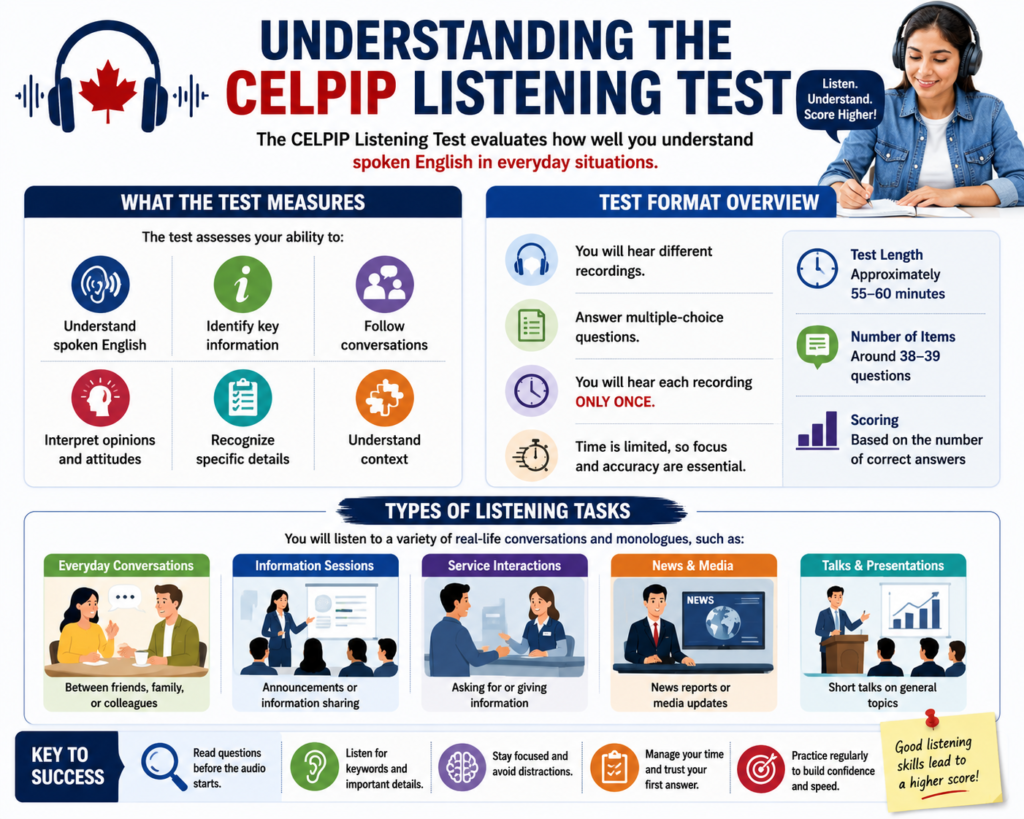
Alt Text: Understanding the CELPIP Listening Test infographic explaining test format, listening tasks, key skills assessed, and preparation tips for higher scores.
Before applying strategies, it is important to understand what the CELPIP listening section evaluates.
The listening test measures your ability to:
- Understand spoken English
- Identify key information
- Follow conversations
- Interpret opinions and attitudes
- Recognize specific details
- Understand context
The test includes various question types and listening situations that reflect real-life communication.
This is why proper CELPIP exam preparation is essential.
Why Candidates Lose Listening Marks
Many test takers possess strong English skills but still lose marks because of poor listening strategies.
Common reasons include:
- Losing focus during recordings
- Reading questions too slowly
- Missing keywords
- Overthinking answers
- Not understanding distractors
- Failing to predict information
Recognizing these challenges is the first step toward improving performance.
Trick #1: Read Questions Before the Audio Starts
One of the most effective CELPIP listening tips is to quickly scan questions before the recording begins.
This helps you:
- Understand the topic
- Identify important keywords
- Predict possible answers
- Focus on relevant information
Instead of listening blindly, you listen with a purpose.
Candidates who preview questions often process information more efficiently.
Trick #2: Focus on Keywords, Not Every Word
Many candidates attempt to understand every word they hear.
This approach often causes unnecessary stress.
Instead, focus on:
- Names
- Dates
- Numbers
- Locations
- Main ideas
- Important actions
Listening for keywords improves concentration and helps you identify correct answers more quickly.
This strategy is especially valuable for those seeking to improve CELPIP listening score performance.
Trick #3: Predict Possible Answers
Prediction is a powerful listening skill.
Before the recording begins, ask yourself:
- What information is likely missing?
- Will the answer be a person, place, number, or opinion?
- What topic is being discussed?
Predicting possible answers prepares your brain to recognize relevant information faster.
This is one of the most effective strategies to score higher in CELPIP listening.
Trick #4: Watch Out for Distractors
CELPIP recordings frequently include distractors.
A distractor is information that sounds correct initially but is later changed or corrected.
For example:
A speaker may say:
“We planned to meet on Friday… actually, let’s move it to Saturday.”
Candidates who stop listening too early may choose the wrong answer.
Always listen until the relevant discussion is complete.
Trick #5: Learn to Identify Tone and Attitude
Not every question focuses on facts.
Some questions require understanding:
- Opinions
- Emotions
- Attitudes
- Intentions
Pay attention to:
- Voice emphasis
- Excitement
- Frustration
- Concern
- Agreement or disagreement
Developing this skill can significantly improve your listening accuracy.
Trick #6: Practice Active Listening
Effective CELPIP listening practice involves active listening rather than passive listening.
Instead of simply hearing audio:
- Focus completely
- Anticipate information
- Track key ideas
- Mentally summarize content
Active listening improves retention and comprehension.
Trick #7: Take Quick Mental Notes
Although extensive note-taking is not always necessary, creating quick mental summaries can be helpful.
Ask yourself:
- Who is speaking?
- What is happening?
- Why is it important?
This technique prevents information overload and improves focus throughout the recording.
Trick #8: Don’t Panic If You Miss Something
Many candidates lose additional marks because they panic after missing one detail.
The reality is simple:
Missing one sentence does not mean you have failed the question.
Stay focused on the remaining audio.
Maintaining concentration is often more important than trying to recover missed information.
Trick #9: Build Listening Stamina
The CELPIP listening section requires sustained concentration.
Many candidates struggle because they lose focus halfway through the test.
To improve endurance:
- Listen to English podcasts
- Watch interviews
- Practice with CELPIP materials
- Gradually increase listening duration
Consistent exposure improves both comprehension and concentration.
Trick #10: Familiarize Yourself with Different Accents
CELPIP primarily uses North American English.
However, speakers may have different speaking styles and accents.
Exposure to various accents helps candidates:
- Adapt more quickly
- Improve comprehension
- Reduce confusion during the exam
This is one of the most overlooked CELPIP listening tips.
Common Mistakes in CELPIP Listening Test
Understanding common mistakes in CELPIP listening test situations can prevent unnecessary score loss.
- Focusing on Every Single Word
Trying to understand everything often causes candidates to miss key information.
- Ignoring Question Keywords
Keywords guide your attention toward important details.
- Overthinking Answers
The simplest answer is often correct.
- Losing Focus After One Mistake
One missed detail should not affect your performance on the rest of the recording.
- Insufficient Practice
Regular CELPIP listening practice is essential for building familiarity and confidence.
Creating an Effective Listening Study Plan
A strong preparation strategy should include:
- Daily Listening Practice
Spend at least 20–30 minutes listening to English content.
- Question-Based Practice
Focus specifically on CELPIP-style listening questions.
- Vocabulary Development
Expand your understanding of commonly used words and expressions.
- Mock Tests
Simulate exam conditions regularly.
- Performance Analysis
Review mistakes and identify recurring weaknesses.
This structured approach supports long-term improvement.
How Long Does It Take to Improve Listening Skills?
Improvement depends on several factors:
- Current English level
- Practice frequency
- Study methods
- Consistency
Most candidates notice progress when they combine daily listening activities with targeted CELPIP preparation.
The key is consistency rather than intensity.
Final Thoughts
Success in the listening section is not about luck—it is about preparation and strategy.
Understanding CELPIP Listening Tricks That Actually Work can help candidates improve focus, recognize important information, avoid common mistakes, and perform more confidently on test day.
By applying these proven CELPIP listening tips, increasing CELPIP listening practice, and using effective strategies to score higher in CELPIP listening, candidates can strengthen their overall exam performance.
Remember that listening is a skill that improves with consistent practice. With the right approach and preparation, achieving your target CELPIP score becomes a realistic and attainable goal. Contact us today for professional guidance.
Related Articles:
- CELPIP to CLB Conversion Explained for Express Entry
- Ontario French-Speaking Skilled Worker Stream
- Can French Help in Getting Canadian Citizenship?
- Is TEF Easier Than IELTS?
- Why French Is Becoming the Smartest Language to Learn for Canada PR in 2026
FAQs
1. What is the best way to improve CELPIP listening skills?
Regular listening practice combined with CELPIP-specific strategies is one of the most effective approaches.
2. How difficult is the CELPIP listening section?
The difficulty varies depending on your English proficiency and familiarity with CELPIP question types.
3. Should I take notes during CELPIP listening?
Quick mental notes or brief observations can help, but excessive note-taking may cause you to miss important information.
4. What are the most common mistakes in CELPIP listening test?
Losing focus, missing keywords, overthinking answers, and failing to recognize distractors are common mistakes.
5. How much listening practice should I do daily?
A consistent 20–30 minutes of focused practice can produce noticeable improvements over time.
6. Are CELPIP recordings played more than once?
No. Recordings are generally played only once, making concentration essential.
7. Can listening to podcasts help with CELPIP preparation?
Yes. Podcasts can improve comprehension, vocabulary, and listening endurance.
8. How can I improve my concentration during listening tasks?
Practice active listening and gradually increase the length of your listening sessions.
9. Why do I miss answers even when I understand English?
Many candidates lose marks because of poor listening strategies rather than language limitations.
10. How long should I prepare for the CELPIP listening section?
Preparation time varies, but consistent practice over several weeks generally produces better results.
