
CELPIP to CLB Conversion Explained for Express Entry
Canada’s immigration system places strong importance on language proficiency, especially for candidates applying through the Express Entry system. One of the most accepted English language tests for immigration is the CELPIP to CLB Conversion system. Understanding how CELPIP scores translate into Canadian Language Benchmark levels can significantly impact your Comprehensive Ranking System (CRS) score and improve your chances of receiving an Invitation to Apply (ITA).
If you are planning to apply for permanent residency through Express Entry, understanding the relationship between CELPIP scores and CLB levels is essential. This guide by Linguoprep explains everything simply and practically.
What Is CELPIP and Why Is It Important for Express Entry?
The Canadian English Language Proficiency Index Program, commonly known as CELPIP, is an English language test approved by Immigration, Refugees and Citizenship Canada (IRCC). The exam evaluates four core language skills:
Listening
Reading
Writing
Speaking
For immigration purposes, candidates often take the CELPIP-General Test. Your scores are then converted into CLB levels using the official CELPIP to CLB Conversion chart.
The Express Entry system uses these CLB levels to calculate eligibility and CRS points. This means your raw CELPIP score alone is not enough. What truly matters is the CLB level associated with your performance.
Many applicants searching for CELPIP score for Canada PR requirements often overlook the importance of CLB conversion. However, even a small improvement in one section can increase your CRS score significantly.
Understanding the Canadian Language Benchmark System
The Canadian Language Benchmark (CLB) is the national standard used to measure English language ability in Canada. It ranges from CLB 1 to CLB 12 and helps immigration authorities assess whether applicants meet the required language standards.
Understanding the Canadian Language Benchmark explained system is crucial because Express Entry programs have minimum language requirements. These include:
Federal Skilled Worker Program
Canadian Experience Class
Federal Skilled Trades Program
Each immigration pathway has different language expectations. Most Express Entry applicants aim for CLB 7 or higher because higher levels provide additional CRS points.
Below is a simplified CELPIP CLB score chart overview:
| CELPIP Score | CLB Level | Express Entry Significance |
| 10 – 12 | CLB 10 – 12 | Highly Advanced (Maximum CRS points) |
| 9 | CLB 9 | Initial Advanced (The “Golden Threshold” for Express Entry) |
| 8 | CLB 8 | Fluent / High Intermediate |
| 7 | CLB 7 | Adequate Intermediate (Minimum for Federal Skilled Worker) |
| 6 | CLB 6 | Developing Intermediate |
| 5 | CLB 5 | Initial Intermediate |
| 4 | CLB 4 | Fluent Basic (Minimum for some PNP streams / Citizenship) |
This conversion applies individually to all four modules. Therefore, your CELPIP listening, reading, writing, and speaking scores are evaluated separately before assigning CLB levels.
For example:
Listening: 9 = CLB 9
Reading: 8 = CLB 8
Writing: 7 = CLB 7
Speaking: 9 = CLB 9
Your final CRS score depends heavily on these individual benchmark levels.
How CELPIP Scores Affect CRS Points in Express Entry
Language proficiency is one of the most important components of the CRS system. Candidates with strong English skills receive higher rankings in the Express Entry pool.
The connection between CRS points for language test results and CLB levels is extremely important. Higher CLB scores unlock additional points in several categories, including:
Core human capital factors
Skill transferability factors
Additional spouse points
For example, moving from CLB 8 to CLB 9 can create a substantial jump in CRS points. This is why many immigration consultants encourage applicants to retake the exam if they are close to CLB 9.
Understanding CLB levels for Express Entry can help candidates create a better immigration strategy. Here is a general breakdown:
CLB 7
Minimum requirement for many Federal Skilled Worker applicants
Basic eligibility benchmark
CLB 8
Competitive level for stronger CRS scores
Improves employability and profile strength
CLB 9
Major CRS boost through skill transferability combinations
Often considered the ideal target score
CLB 10+
Maximum language points in several categories
Excellent for highly competitive draws
Many applicants researching Express Entry language requirements discover that language scores can make or break an application. Even candidates with strong education and work experience may struggle with low CLB levels.
This is why preparation plays a critical role. A well-planned study strategy can help improve your CELPIP performance and increase your overall immigration chances.
Common CELPIP Score Targets for Canada PR Applicants
When preparing for immigration, candidates frequently ask what score they should aim for. The answer depends on your profile, occupation, and target CRS score.
However, most immigration experts recommend aiming for CLB 9 because it maximizes language-related CRS benefits.
Here are common CELPIP score for Canada PR targets:
| Target CLB Level | Recommended CELPIP Module Score | Focus Area & CRS Impact |
| CLB 7 | 7 in each module (Listening, Reading, Writing, Speaking) | The absolute baseline for the Federal Skilled Worker (FSW) program. |
| CLB 8 | 8 in each module | A strong mid-tier score that provides a solid boost to your profile. |
| CLB 9 | 9 in each module | The “Golden Threshold.” Hitting a 9 across all four modules triggers a massive jump in Comprehensive Ranking System (CRS) skill transferability points. |
| CLB 10+ | 10 to 12 in each module | Maximises your language points entirely, giving you the highest competitive edge possible. |
Achieving CLB 9 can significantly improve your eligibility under the Express Entry language requirements system.
Candidates should also understand that inconsistent scores across modules can lower their final benchmark profile. For example:
Listening: 10
Reading: 9
Writing: 6
Speaking: 9
Even though three modules are excellent, the Writing section may reduce eligibility for certain immigration pathways.
This is why balanced preparation matters. Focus equally on all four sections:
Listening accuracy
Reading comprehension
Structured writing
Speaking fluency
Improving your CELPIP listening reading writing speaking scores together creates a stronger immigration profile.
Tips to Improve Your CELPIP Score and Reach Higher CLB Levels
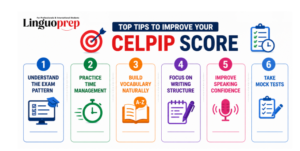
Scoring well on CELPIP requires smart preparation, consistent practice, and familiarity with the exam format. Many candidates struggle because they focus only on grammar while ignoring test strategy.
Here are some practical ways to improve your CELPIP to CLB Conversion outcome:
Understand the Exam Pattern
Before starting preparation, understand:
Question types
Time limits
Scoring methods
Computer-based format
Knowing the structure reduces stress during the exam.
Practice Time Management
Many candidates lose marks because they spend too much time on difficult questions. Learn how to manage time effectively in all sections.
Build Vocabulary Naturally
Instead of memorising difficult words, focus on:
Daily English conversations
News articles
Podcasts
Canadian accents
This improves comprehension and fluency naturally.
Focus on Writing Structure
The Writing section requires:
Clear organization
Logical arguments
Proper grammar
Strong vocabulary
Using templates can help improve consistency.
Improve Speaking Confidence
For the Speaking module:
Record your answers
Practice speaking clearly
Avoid speaking too fast
Focus on pronunciation
Confidence and clarity matter more than complicated vocabulary.
Take Mock Tests
Mock tests help identify weaknesses in your preparation. They also improve familiarity with real exam pressure.
Many students preparing for CLB levels for Express Entry benefit from repeated practice tests because they learn how scoring works across modules.
Final Thoughts
Understanding the CELPIP to CLB Conversion process is essential for anyone planning to immigrate to Canada through Express Entry. Your CELPIP scores directly influence your CLB levels, which ultimately determine your CRS ranking and immigration opportunities.
A strong understanding of the CELPIP CLB score chart, proper preparation, and consistent practice can help applicants achieve competitive scores for Canadian permanent residency.
Since language proficiency carries significant weight in the immigration process, improving your CRS points for language test performance can dramatically strengthen your profile.
Whether you are targeting CLB 7 for eligibility or CLB 9 for maximum CRS benefits, strategic preparation is the key to success.
For expert CELPIP coaching, preparation resources, and personalised guidance, visit Linguoprep and take the next step toward your Canadian immigration journey.
Frequently Asked Questions
1. What is CELPIP to CLB Conversion?
CELPIP to CLB Conversion is the process of converting CELPIP test scores into Canadian Language Benchmark (CLB) levels used for Canadian immigration programs like Express Entry.
2. Why is CLB important for Express Entry?
CLB levels for Express Entry determine your eligibility and influence your CRS score. Higher CLB scores can improve your chances of receiving an Invitation to Apply (ITA).
3. What is the minimum CELPIP score required for Canada PR?
The minimum CELPIP score for Canada PR depends on the immigration program. Most Federal Skilled Worker applicants need at least CLB 7, which usually means a score of 7 in each module.
4. What is CLB 9 in CELPIP?
CLB 9 corresponds to a CELPIP score of 9 in Listening, Reading, Writing, and Speaking. Achieving CLB 9 can significantly increase CRS points for language test results.
5. How are CELPIP scores calculated?
Your CELPIP listening reading writing speaking scores are evaluated separately. Each section receives an individual score that converts into a CLB level.
6. Where can I find the CELPIP CLB score chart?
The official CELPIP CLB score chart is available through IRCC and CELPIP official resources. It helps candidates understand how their scores translate into CLB levels.
7. Does Express Entry accept CELPIP?
Yes, CELPIP-General is officially approved by IRCC and accepted for meeting Express Entry language requirements.
8. Can improving my CELPIP score increase CRS points?
Yes, better language scores can improve your overall CRS ranking. Higher CRS points for language test performance often leads to stronger Express Entry profiles.
9. What is the highest CLB level in CELPIP?
The highest benchmark is CLB 12, although most immigration scoring benefits peak around CLB 9 or CLB 10.
10. How can I improve my CELPIP score?
To improve your CELPIP score for Canada PR, practice mock tests, improve vocabulary, work on time management, and strengthen all four language modules equally.
